
IACV explained

max

Road warrior
Thread starter
Just thought i would explain what the Intake Air Control Valve is, what it does where it is and why it took so long to replace the thing.

This is a team effort and i only scraped some bits together, so thanks to the team!

This valve is actually an electric motor, it looks like a battery toy motor but works by making it step 8 precise times per revolution, hence the "stepper " motor.

In our cb1100 it replaces the idle screw that most of us are familiar with, it adjusts the idle speed of the engine, 1500 rpm when cold and as the engine warms up it gradually " steps " the idle back to 1050 rpm.

The Electronic Control Module does not know in which position the iacv is, so on startup it tells it to open up 168 steps divided by 8 is 21 revolutions.
The bike starts in this position and gradually steps to 72 steps ( 9 revolutions ).
From that point on the iacv keeps stepping the valve to maintain 1050 rpm at any temperature or altitude.

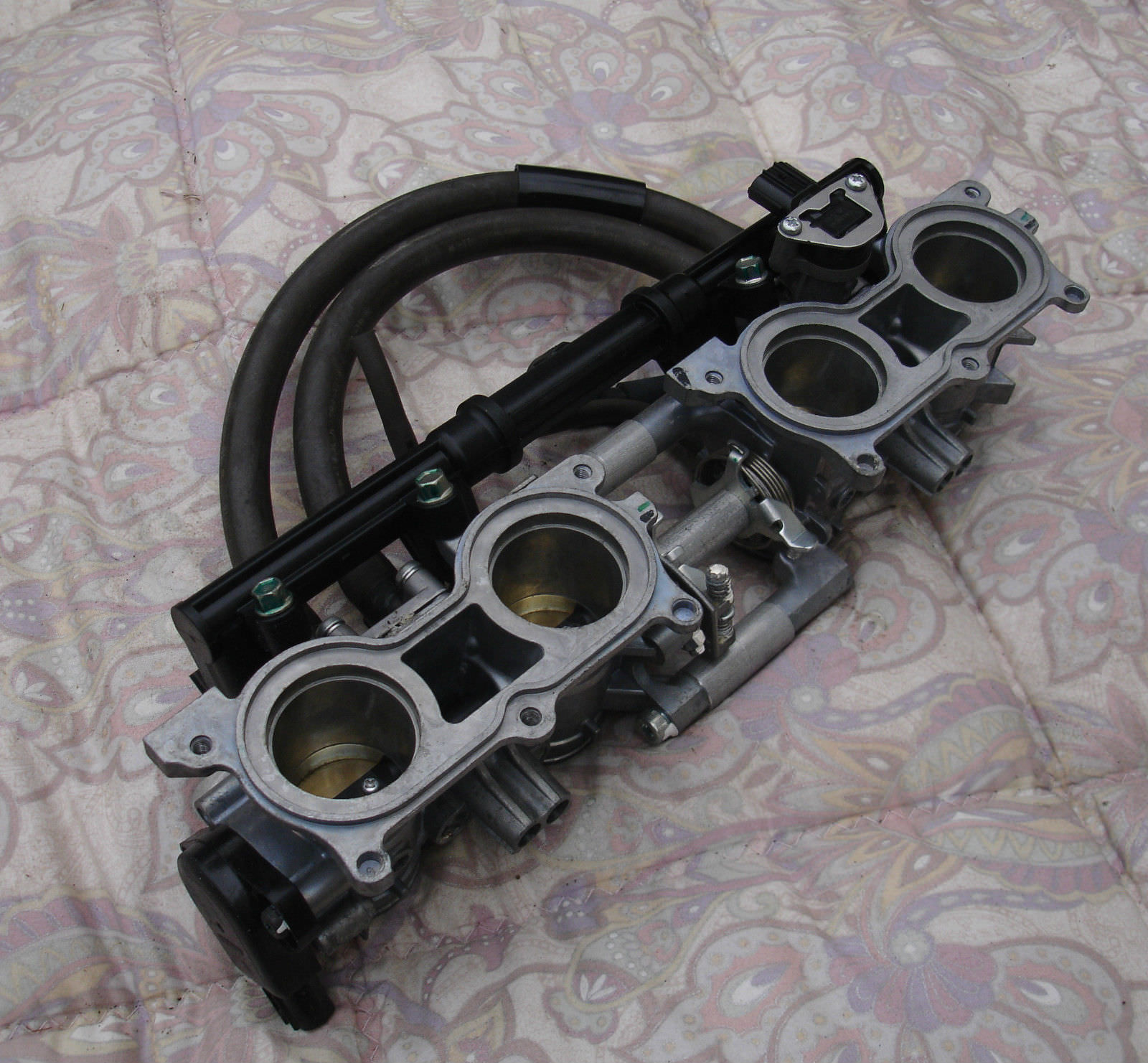
Here it can be seen mounted on the throttle body at the very top of the picture with 2 screws and a bracket
79b00664e0ef770eabb0ae85ff5ca933.jpg


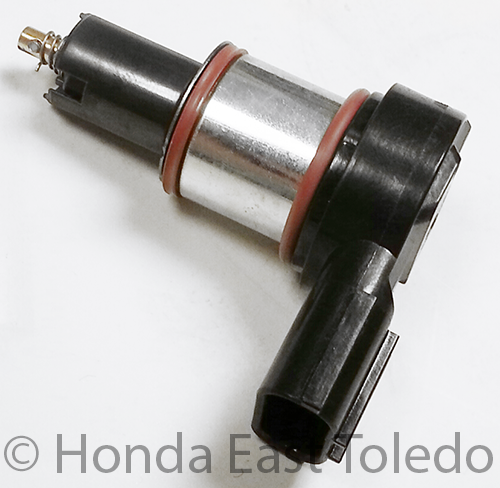
here is a picture of an iacv, notice the spring at the end of the piston.
36efcaee5150fcb6e895aa470e7d9d00.png


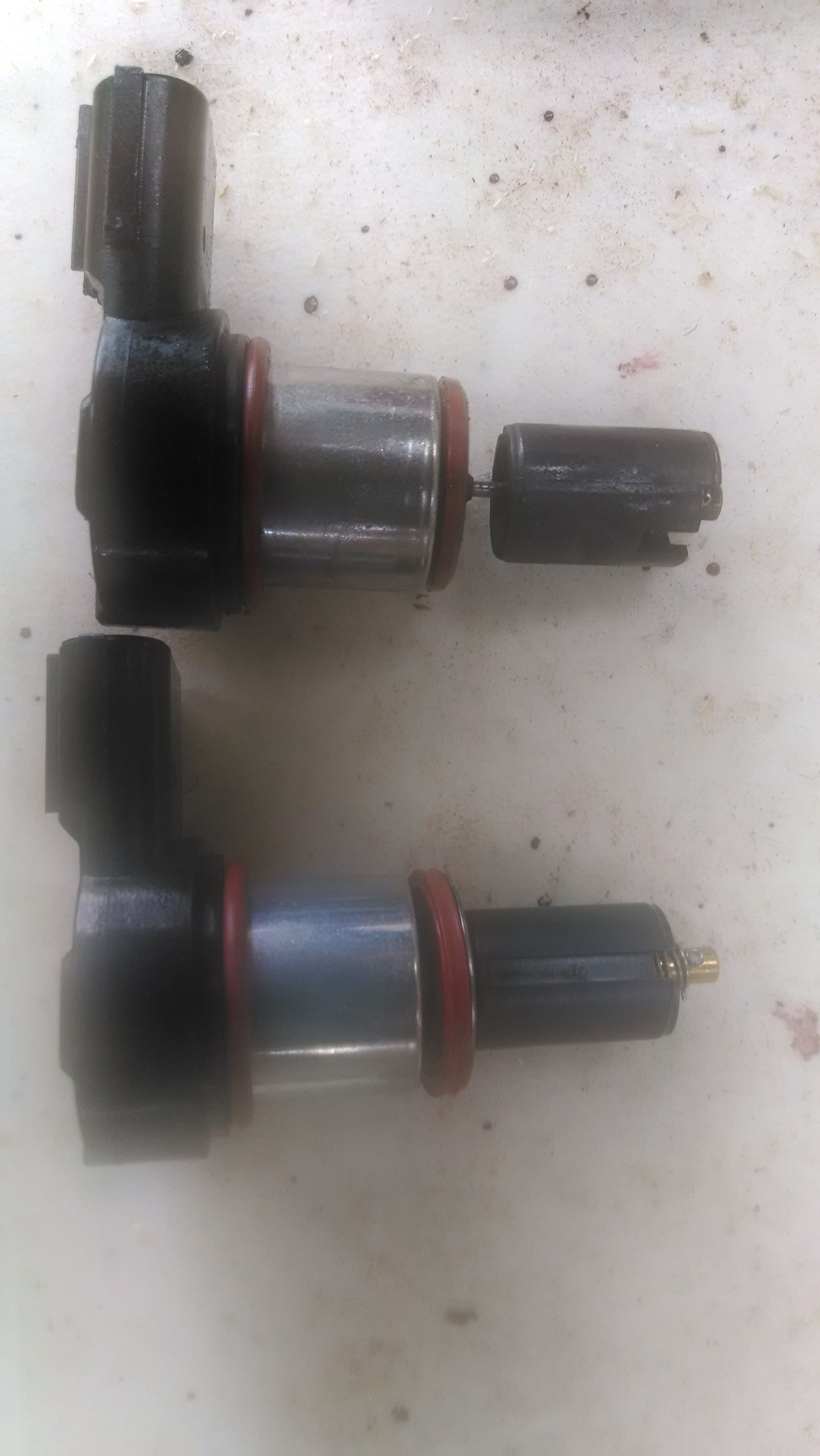
Here is a fuzzy picture showing the piston in and extended.
5dc48565809722ca860451cc55691baa.jpg


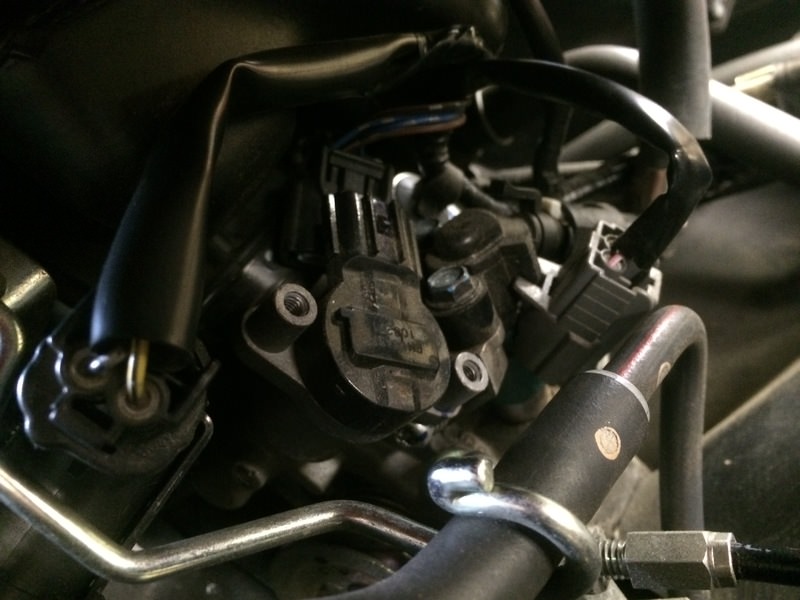
here is an iacv in the throttle body with the two screws and bracket removed ( not a cb1100 but similar mounting and operation ).
48659709369441049cc30233a71061cd.jpg


And the same engine with the iacv removed, notice the pin in the barrel where the piston moves in and out to regulate idle air.
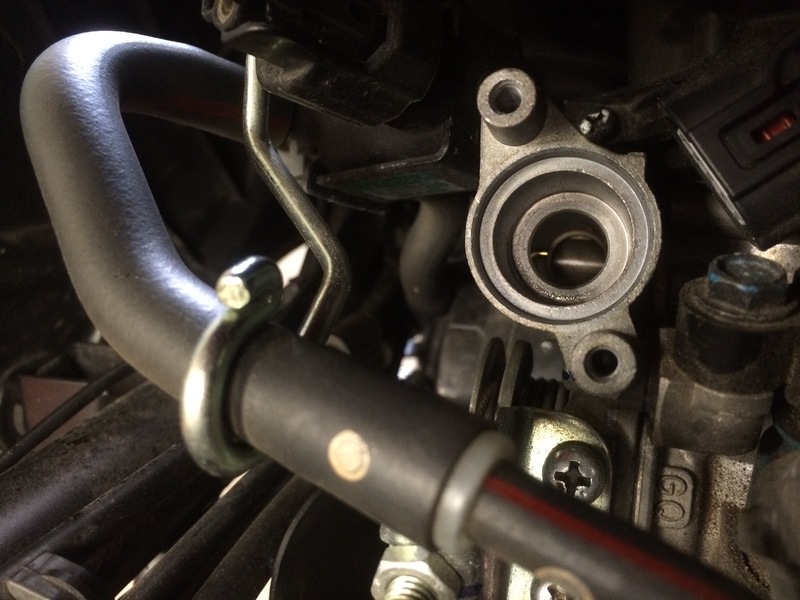
c8187e6b90a98ca1967a590c5ce1e926.jpg


you may also notice that the iacv was replaced with success to remedy an idle problem despite the engine looking not very old hmmmm.

So why did it take us so long to fix it? it is not a trivial job and we wanted to be as sure as possible prior to advice replacing it, have a look at this post from Magnus in the idle instability thread.

http://cb1100forum.com/forum/showthread....20&page=22

If you scroll down the page there is another picture.

We all knew it was the iacv that was not working correctly, the question is why?

max
 
max_imp said:
Just thought i would explain what the Intake Air Control Valve is, what it does where it is and why it took so long to replace the thing.

This is a team effort and i only scraped some bits together, so thanks to the team!

This valve is actually an electric motor, it looks like a battery toy motor but works by making it step 8 precise times per revolution, hence the "stepper " motor.

In our cb1100 it replaces the idle screw that most of us are familiar with, it adjusts the idle speed of the engine, 1500 rpm when cold and as the engine warms up it gradually " steps " the idle back to 1050 rpm.

The Electronic Control Module does not know in which position the iacv is, so on startup it tells it to open up 168 steps divided by 8 is 21 revolutions.
The bike starts in this position and gradually steps to 72 steps ( 9 revolutions ).
From that point on the iacv keeps stepping the valve to maintain 1050 rpm at any temperature or altitude.

Here it can be seen mounted on the throttle body at the very top of the picture with 2 screws and a bracket
79b00664e0ef770eabb0ae85ff5ca933.jpg


here is a picture of an iacv, notice the spring at the end of the piston.
36efcaee5150fcb6e895aa470e7d9d00.png


Here is a fuzzy picture showing the piston in and extended.
5dc48565809722ca860451cc55691baa.jpg


here is an iacv in the throttle body with the two screws and bracket removed ( not a cb1100 but similar mounting and operation ).
48659709369441049cc30233a71061cd.jpg


And the same engine with the iacv removed, notice the pin in the barrel where the piston moves in and out to regulate idle air.
c8187e6b90a98ca1967a590c5ce1e926.jpg


you may also notice that the iacv was replaced with success to remedy an idle problem despite the engine looking not very old hmmmm.

So why did it take us so long to fix it? it is not a trivial job and we wanted to be as sure as possible prior to advice replacing it, have a look at this post from Magnus in the idle instability thread.

http://cb1100forum.com/forum/showthread....20&page=22

If you scroll down the page there is another picture.

We all knew it was the iacv that was not working correctly, the question is why?

max

Thanks so much for the explanation and photos as I dislike mysterious acronyms for parts that I'll never be able to verbalize how they work and what their purpose is on my own.

Wait...Does "the question is why" mean you're still looking?...or is that a quiz questions and we're supposed to fill in the answer? ...or are you building up suppense like a mystery novel?
 
Thread starter
Well some months ago i had no idea that i even HAD one until cormanus put me straight, so i guessed others may have the same question.

We were hoping to prove that a particular part was at fault just so all involved could just go ahead and repeat the procedure, so a lot of reasoning went on and after all that we now know how it works but don't yet know which part is faulty, all we know is that the 1600+ dollars replacement clears the problem and provides the owner with the bike that he paid for, that seems a bit steep for a small part or even a poor contact, so we did all these tests.

The question is;
a; does the iacv do what the ecm tells it or
b; does it get told to do the right thing but is unable to do so from time to time.

We are still checking wiring but that is just to be sure all the possibilities have been covered, we don't know.

On a more dramatic note; the bike has developed a fault, was it caused by the rider or the manufacturer?

Don't answer that. max
 
Personally, I think your (collective Max, PB, Doc, Popgun et al) wisdom experience, and willingness to help in dealing with this issue is phenomenal. Beyond words.
 
Well done, Max!

I got involved in this issue late, with focus on vacuum leak, poor connections, TPS and IACV.

Which is why the 27 Dec summary was in this order:
check codes (active and stored)
check for vacuum loss (minor = high idle, major = close to stalling/stalling)
check TPS (FSM symptom/fail safe: hard to start cold)
check IACV (FSM symptom/fail safe: engine stalls, hard to start, rough idle
check EOT (FSM symptom/fail safe: poor acceleration) symptoms did not match, but it was a concern, earlier.

No concern about MAP or IAT, as symptoms did not match.

I was ready to move on from TPS testing before MAX test's were complete, but did not want to interfere with completion of those tests...plus a lot of distractions, last week.

And, if IACV replacement is not an immediate cure, at least the TPS testing was thorough AND we all got an education.

Also, there may have been more than one issue, although the FSM would lead basic diagnostics to the IACV, per FSM pages 5-15 & 5-16.

There is still a possibility of a poor connection in the connector, damage to the wires into the IACV connector or the stepper motor driven "piston" not moving freely.

DTC 29-1, FSM page 5-16, lists IACV circuit malfunction as "loose or poor contact of IACV connector, IACV or its circuit malfunction". The piston not moving as much as the stepper steps would not likely provide a DTC (opinion)

Max pointed out the alignment pin, which prevents the piston from rotating when the motor drives it in and out.

When the IACV is replaced, it would be prudent to well clean the piston port, port air passages and maybe even spray with a shot of silicone lubricant.

4624 miles on my 2014 CB1100 standard in <3 1/2 months.
No issues.
I do not abuse it (easy on throttle until engine comes up to temp, then after warm, rarely over 6,500 RPMs, never bumped the rev limiter), but it does not accumulate cobwebs.
Spark plugs look like new.
Typical MPG is 48-54, as good as my 2016 Moto Guxxi V7II, 744cc!
Worst instant MPG was 24.something, accelerating from 70 to 110 in 6th gear, ~2% uphill grade.
Most trips are about 51-52 MPG
I remain extremely pleased with it.
Stock other than Dart Martin flyscreen, air intake mod, LED tail/brake light and just replaced license plate bracket with a lay-down 4" x 7" stainless steel plate. Saved the cardboard template, should anyone else be interested.
 
Amazing work, gentlemen. I wish I understood even half of it.
 
Cormanus_imp said:
Amazing work, gentlemen. I wish I understood even half of it.
I expect you actually do.
This link is automotive, but generally applicable
Note both high and low idle symptom possibilities (as well as vacuum issues...so you will understand my frequent preaching on the possibility)

3 Ways to Check an Idle Air Control Valve - wikiHow
 
max_imp said:
Well some months ago i had no idea that i even HAD one until cormanus put me straight, so i guessed others may have the same question.

We were hoping to prove that a particular part was at fault just so all involved could just go ahead and repeat the procedure, so a lot of reasoning went on and after all that we now know how it works but don't yet know which part is faulty, all we know is that the 1600+ dollars replacement clears the problem and provides the owner with the bike that he paid for, that seems a bit steep for a small part or even a poor contact, so we did all these tests.

The question is;
a; does the iacv do what the ecm tells it or
b; does it get told to do the right thing but is unable to do so from time to time.

We are still checking wiring but that is just to be sure all the possibilities have been covered, we don't know.

On a more dramatic note; the bike has developed a fault, was it caused by the rider or the manufacturer?

Don't answer that. max
The IACV is a very simple mechanical part; all it does is adjust the idle mechanically based on what the ECU has calculated.

There are several sensors at play here, and the combined values from those sensors are used to actively adjust the IACV in real time whenever the throttle is closed.

I don't have my manual any more, or I could look this control circuit up myself.

However, it doesn't much matter which sensors are involved; we need to find them, find out what parameters are being observed, and then what calculations and algorithm are used to send the final signal for adjustment to the IACV.

This is directly related to emissions control compliance so it is very likely the process is pretty complex. But it can be corrected. Most bikes don't have this problem. It is fixable. Somewhere in the chain, something needs to be modified, replaced, or adjusted.

QUESTION #1

Why does the idle need to be constantly adjusted in real time? Why not just have a set screw you can reach down and turn?

ANSWER

Idle is the time when the engine is producing the most emissions, under the worst circumstances. Most idling is done in urban traffic at a stop, where the pollutants are just pumping into the air and doing the most damage. So the engine's fuel mixture and idle speed need to be very carefully controlled under those conditions.

Also the ECU monitors electrical loads and the charge state of the battery. The idle will temporarily increase to provide more current from the alternator if necessary.

QUESTION #2

Which sensors are involved?

ANSWER

Typical sensors are air intake temperature, throttle position, airbox pressure, engine temperature (oil temperature is critical as it's air/oil-cooled), exhaust gas temperature, and oxygen sensor values. I don't know which are involved with the CB1100 but that is a typical array.

If any of those sensors are faulty the signal sent to the IACV is going to be erroneous and cause an issue.

The sensors usually provide a voltage of 0-5 volts to the ECU which then converts this voltage to an output reflecting the actual value of the units. It combines these various sensor channels and then uses a calculation based on math channels or algorithms or some other process.

If any of these processes are flawed within the ECU programming, THAT could be the issue right there. In that case a reflash/reprogram of the ECU with a program proven to work is all that's needed.

If we have sensors with intermittent issues, or bad conversions of analog to digital values, or any corruption or hysteresis in the system (that is a fancy work for uneven response) that can cause a problem as well.

Having worked with some fairly complex systems that used this kind of architecture, I'd say the problem is NOT likely to be the IACV. It's a simple electro-mechanical device. It's more likely a sensor, or bad calculation in the ECU.

However, it's possible Honda had a bad run of IACV units and some of those got into a few bikes.

The IACV would, therefore, be the FIRST place to look since it's the simplest solution. Then proceed to the various sensors.

But if those all check out, the ECU programming -- or the ECU itself -- could well be the culprit.

Heat has a way of really messing with computers. So does vibration. There are lots of both in a motorcycle.

Lastly, if the owner hasn't modified the bike in any way, and just rode it normally, there's no way the owner could do anything to disrupt this function. Changing intake/exhaust features might do it, but should not. Again, this is going to be based on whether the ECU can correct for the these changes, or will produce erratic/erroneous values.

Riding the bike hard, bouncing it off the rev limiter, none of that is going to hurt this Honda. One thing I know for sure, since I've done did all that. I never worried about the reliability of that bike. It loves to be "rode hard and put away wet".
Just an addendum, "IACV" stands for "Idle Air Control Valve".

Click the link for more.
 
Re post 8, from post 5:

vacuum loss (minor = high idle, major = close to stalling/stalling)
TPS (FSM symptom/fail safe: hard to start cold)
IACV (FSM symptom/fail safe: engine stalls, hard to start, rough idle
EOT (FSM symptom/fail safe: poor acceleration)

DTC 29-1, FSM page 5-16, lists IACV circuit malfunction as "loose or poor contact of IACV connector, IACV or its circuit malfunction".

Otherwise, per the FSM, other sensors failsafe is normal engine operation, this includes MAP, IAT and O2. There is no mass flow sensor or exhaust temp sensor on the CB1100.

The FSM incudes all sensors on pages 5-15 and 5-16.

Symptoms reported are classic for IACV.

The piston not moving as much as the stepper steps would not likely provide a DTC (opinion) and this may be more likely than any other aspect of the IACV operation.

This would likely be from carbon build-up, perhaps induced by short trips, low speeds, and maybe even by high octane fuel (slower burn, less energy), and/or non tier one (highest level of cleaning additives) fuel, etc.

Dave's issue is not yet resolved, but if the IACV is replaced, with proper cleaning and wiring inspected, it is a highly likely fix...if the IACV piston travels freely within the port. When the IACV was replaced, without success, the throttle body port may have been an issue.

BTW, the IACV is not a simple solution, access is a pain...which is why the team has gone through the process of elimination.
 
SportsterDoc_imp said:
Re post 8, from post 5:

vacuum loss (minor = high idle, major = close to stalling/stalling)
TPS (FSM symptom/fail safe: hard to start cold)
IACV (FSM symptom/fail safe: engine stalls, hard to start, rough idle
EOT (FSM symptom/fail safe: poor acceleration)

DTC 29-1, FSM page 5-16, lists IACV circuit malfunction as "loose or poor contact of IACV connector, IACV or its circuit malfunction".

Otherwise, per the FSM, other sensors failsafe is normal engine operation, this includes MAP, IAT and O2. There is no mass flow sensor or exhaust temp sensor on the CB1100.

The FSM incudes all sensors on pages 5-15 and 5-16.

Symptoms reported are classic for IACV.

The piston not moving as much as the stepper steps would not likely provide a DTC (opinion) and this may be more likely than any other aspect of the IACV operation.

This would likely be from carbon build-up, perhaps induced by short trips, low speeds, and maybe even by high octane fuel (slower burn, less energy), and/or non tier one (highest level of cleaning additives) fuel, etc.

Dave's issue is not yet resolved, but if the IACV is replaced, with proper cleaning and wiring inspected, it is a highly likely fix...if the IACV piston travels freely within the port. When the IACV was replaced, without success, the throttle body port may have been an issue.

BTW, the IACV is not a simple solution, access is a pain...which is why the team has gone through the process of elimination.
For a complete failure of the sensor, fail safe...yes. But a sensor operating but providing faulty corrupted information, not properly calibrated: no. Any one of those sensors could be providing data that is slightly out of calibration, just enough to cause this "hunting" by the step motor. Very common in these kinds of systems. Unplug each sensor one by one and check the result to find out what happens. (CAUTION when test riding).

Has anyone checked the crank sensor that provides RPM information? That would be a place to look right away. If that was dirty, damaged, or displaced for any reason that could sure be a potential cause.

Also, while access may be a pain, it's still simple compared to a complete tear-apart for access to the top of the engine to check the valves. That's an all-day job. Whatever it takes to get it running correctly, it has to be done.

But the thing of it is, it's a $1600 part! That's 20 percent of the cost of the bike new in most cases, and a third the value of a used bike that runs properly.

I can really see how this would chap the hide of some owners.

If I had this problem, here is what I would do:

1. Obtain an ECU from your buddy's CB1100 which runs perfectly, and replace yours with the good one. If your bike runs fine, maybe that's it, and you could have your ECU reflashed with the current program.

2. Methodically test every sensor involved in combustion; if they do all "fail safe" then just unplug every single one, one at a time, and see if the bike runs better.

3. Remove and test the IACV. If bad...fight with Honda to have it replaced or at least a discount, or perhaps find another from a salvage yard. Or despair in having to cough up the dough.

See where that takes you. Just remember to always use CAUTION when test riding.
 
Re post 10:

I'm familiar with crank position sensor operation. See post one of this thread: http://xlforum.net/vbportal/forums/showt...371&page=2
A failed CPK will not fire. A failing one will cause misfires. It does not match the symptoms.

As for testing sensors, the EOT and TPS have been unplugged and reported in the threads. Posts 35 and 58 in the tps eval for ii issues thread provided values and Dave reported in-spec values in post 59.

All these steps have been documented.

Swapping ECMs is a suggestion in the FSM if there is not 5 vdc sensor power to MAP (5-20), EOT (5-21) and IAT (5-26). Swapping to check for a program glitch is reasonable, if one is available. If nothing else, it is an opportunity to wipe/cycle the ECM connector contacts.

As for erratic output, see posts 1 and 19 of this thread: [URL=https://cb1100forum.net/threads/68227/]http://cb1100forum.com/forum/showthread.php?tid=11893


In the case of a DTC 1-1 MAP lo, circuit voltage is < 0.2 vdc
This covers "MAP sensor or its circuit malfunction" and fail-safe is "engine operates normally".

In the case of a DTC 1-2 MAP hi, circuit voltage is > 3.9 vdc.
This covers "loose or poor contact of MAP sensor connector" and "MAP sensor or its circuit malfunction" and fail-safe is "engine operates normally".

Just glancing at pages 5-15 and 5-16 shows how well the CB1100 will continue to perform with many sensor codes.

If the EOT is wonky, the only issue is hard starting cold.

If the IAT is wonky, default is 95 F.

If TPS is wonky, default is 0 degrees position

If an O2 sensor is wonky, "engine operates normally"

However, if a fuel injector faults, it is time to push: Engine does not start, injector power, pump and ignition shut down in the event of "loose or poor contact of the fuel injector connector-fuel injector or its circuit malfunction"...fail-safe is not just complete failure...it is out of spec parameters.

I do not have all the answers. At age 71 I am still learning and it took me a while to come up to speed on this issue, at least in trying to understand what worked in the past, what did not work and to figure out why it may not have worked, if it was a reasonable diagnosis. However, the tests done over the last couple months have been thorough, are in harmony with the FSM and compatible with available data on automotive IACV issues.

The absence of codes or the absence of codes being reported added to the challenge.
 
Can someone tell me the part number of this very expensive IACV, please?

If it's just the item Max posted a picture of in #1 of this thread, it's surely not US$1,600. That would buy you pretty much the core of a new throttle body, wouldn't it? Or is the point that you have to replace the entire throttle body?
 
Thread starter
Cormanus_imp said:
Can someone tell me the part number of this very expensive IACV, please?

If it's just the item Max posted a picture of in #1 of this thread, it's surely not US$1,600. That would buy you pretty much the core of a new throttle body, wouldn't it? Or is the point that you have to replace the entire throttle body?
Here you go sir, courtesy of sportsterdoc;
http://www.2wheelpros.com/oem-parts/2014-honda-cb1100-throttle-body-assembly.html#

It is item # 4 motor assembly. The IACV is 16430-MJF-D01
i also believe there is a later version which is more expensive

According to what i have heard honda only sells the entire throttle body as a spare part hence the hefty price tag.
 
Thanks Max, that's what I thought.

So the critical part is US$96, but you can't have it unless you spend at least US$1,000 on part #3. Or do they insist you buy #2 at US$1,450?
 
Isn't the IACV part number 16430-MFJ-D01? I see that this part lists for $119.13. Does this $1,600.00 include the labor fee?

It looks like I'll be replacing mine, as soon as I can complete the work I'm doing on my VFR800, so I can make room in my garage. This looks like a fairly involved task, and will probably take me an entire Saturday (yes, I'm slow, but I take my time and am very careful, especially when working on something new and for the first time).

I can hear my IACV cycling by listening to the clicking noises it make at start up. Does this mean that it is stuck, and that maybe all it needs is to be cleaned?
 
max_imp said:
Cormanus_imp said:
Can someone tell me the part number of this very expensive IACV, please?

If it's just the item Max posted a picture of in #1 of this thread, it's surely not US$1,600. That would buy you pretty much the core of a new throttle body, wouldn't it? Or is the point that you have to replace the entire throttle body?
Here you go sir, courtesy of sportsterdoc;
http://www.2wheelpros.com/oem-parts/2014-honda-cb1100-throttle-body-assembly.html#

It is item # 4 motor assembly. The IACV is 16430-MJF-D01
i also believe there is a later version which is more expensive

According to what i have heard honda only sells the entire throttle body as a spare part hence the hefty price tag.
Max, I expect you are thinking of the TPS not being listed as separate from the throttle body. The IACV is available, from various sources, such as Honda, BikeBandit, etc.

The "advantage" of purchasing the entire throttle body assembly (2wheel pros shows $1,327.78 list, offered by them for $1,000.48) is that the IACV port would be clean, not warped, with new IACV and new TPS.

Not suggesting this, just clarifying.
Dave_imp said:
Isn't the IACV part number 16430-MFJ-D01? I see that this part lists for $119.13. Does this $1,600.00 include the labor fee?

It looks like I'll be replacing mine, as soon as I can complete the work I'm doing on my VFR800, so I can make room in my garage. This looks like a fairly involved task, and will probably take me an entire Saturday (yes, I'm slow, but I take my time and am very careful, especially when working on something new and for the first time).

I can hear my IACV cycling by listening to the clicking noises it make at start up. Does this mean that it is stuck, and that maybe all it needs is to be cleaned?
Max may answer this better than I, but hearing the IACV cycling indicates that the stepper motor is stepping or trying to step. If crud is preventing full operation, it may not sound much different. The ECM has no feed-back regarding actual movement. For that a servo motor would be appropriate, with an encoder.

Also, it could be moving properly, but an air passage blocked/partially blocked. My only comparison is automotive and comparing ours to a Honda Civic is a different animal.

Again, my suggestion is to first disconnect and then reconnect and see if that makes any difference. Unbolting, lifting the tank and removing the right throttle body cover, disconnecting IACV, feeling for a break in the wires, checking contacts, reconnecting IACV, replacing the cover, lowering and rebolting the tank is only about a 20 minute job. Maybe I took 30 minutes, including taking photos to send to you via email.

Max did a video on using a block of wood to keep the tank up for access to the left side for the TPS, to gain slack in the TPS cable.

Popgun is researching IACV tests on page 5-41 (5-42?) of the manual, which may allow additional electrical testing before removing the IACV. I do not have the manual, so all the FSM info has been courtesy of Popgun.
 
Dave_imp said:
Isn't the IACV part number 16430-MFJ-D01? I see that this part lists for $119.13. Does this $1,600.00 include the labor fee?

It looks like I'll be replacing mine, as soon as I can complete the work I'm doing on my VFR800, so I can make room in my garage. This looks like a fairly involved task, and will probably take me an entire Saturday (yes, I'm slow, but I take my time and am very careful, especially when working on something new and for the first time).

I can hear my IACV cycling by listening to the clicking noises it make at start up. Does this mean that it is stuck, and that maybe all it needs is to be cleaned?
A while back, I believe Riko stated his throttle body replacement under warranty would have cost north of $3000, and that John1954 (?) had the IACV replaced at $1500 roughly, again under warranty; most of which was labor if I recall correctly.
 
Cormanus_imp said:
Thanks Max, that's what I thought.

So the critical part is US$96, but you can't have it unless you spend at least US$1,000 on part #3. Or do they insist you buy #2 at US$1,450?
The part strongly suspected of being the main problem is the IACV, which 2wheelpros lists for $95.66. There are several sources, which I would shop for price and delivery costs.

Part 3 is the entire throttle body, which includes that part.

Again, there have been some issues other than the IACV, such as TPS wires and replacing the IACV did not work for a couple forum members...but that may be due to the piston not moving freely and/or air passage obstructions.
pdedse_imp said:
Dave_imp said:
Isn't the IACV part number 16430-MFJ-D01? I see that this part lists for $119.13. Does this $1,600.00 include the labor fee?

It looks like I'll be replacing mine, as soon as I can complete the work I'm doing on my VFR800, so I can make room in my garage. This looks like a fairly involved task, and will probably take me an entire Saturday (yes, I'm slow, but I take my time and am very careful, especially when working on something new and for the first time).

I can hear my IACV cycling by listening to the clicking noises it make at start up. Does this mean that it is stuck, and that maybe all it needs is to be cleaned?
A while back, I believe Riko stated his throttle body replacement under warranty would have cost north of $3000, and that John1954 (?) had the IACV replaced at $1500 roughly, again under warranty; most of which was labor if I recall correctly.
Good point. In the custom industrial automation business (assembly robotics, etc.) labor is typically 65% of a project and a Honda dealer typically charges full list for parts.

BTW there is a 50+ post thread on XLForum.net regarding high idle issues.
Sportster went EFI in 2007. This thread started April 2011 and the latest post was this morning. Some Sportster riders, such as Tracy in OZ, reported the issue occurred day 1 on her 2008.

Main "fix" was IACV. Second was TPS. One was reported as EOT.

It is amazing how many EFI bike brands/models have experienced this issue.
 
Thread starter
Dave_imp said:
Isn't the IACV part number 16430-MFJ-D01? I see that this part lists for $119.13. Does this $1,600.00 include the labor fee?

It looks like I'll be replacing mine, as soon as I can complete the work I'm doing on my VFR800, so I can make room in my garage. This looks like a fairly involved task, and will probably take me an entire Saturday (yes, I'm slow, but I take my time and am very careful, especially when working on something new and for the first time).

I can hear my IACV cycling by listening to the clicking noises it make at start up. Does this mean that it is stuck, and that maybe all it needs is to be cleaned?
Sorry Dave, i was wrong, i mixed up the iacv with the tps in my mind,thanks sportsterdoc, apologies to all for the confusion, you guys are right, the iacv IS available as a separate spare part from Honda.

There is some good news from johnf415, he replied to a question and said;
----------------------------------------------------------------------------------------------
Hi Max,

My bike had the high idle issue, where the engine would idle without any throttle input above 1500 RPM, sometimes surging up to 2000.

However, I did also have the low idle issue at times, although not as frequently, and the behavior was as you described. The engine would drop in revs down to 600-700, and slowly creep back to 1050 if left alone. I recall a couple of stalls, but usually I would avoid that by adding throttle.

I hope this helps, happy to contribute as needed to solve this gremlin!

John

max Wrote:
Hi John, still trying to find the exact fault the slow way, sorry to ask but Dave reports that the bike takes 5 to 10 seconds to go from 700 rpm to 1050 rpm, from memory is that what happened to your bike at any stage or was it just stuck at low rpm all the time?

Just trying to compare the symptoms before i ask him to replace the iacv.

Thanks max
---------------------------------------------------------------------------------------------------
Sometimes it is the small details that matter, and this makes me feel more confident that the iacv replacement is going to work, by all means clean the iacv contacts first, you may get a pleasant surprise.
 
I have sent Sportsterdoc the info he requested and I would suspect he will post on it later. I would, but I’m letting Max and Doc do the posting. They are better at it :)

Changing or getting to the IACV is a LOT of work. Thus the heavy labor charge. Just accessing the connector is easy as Doc has shown.
 
Back
Top