Cold Weather & Tire Pressure

2017EX_imp

Been there
Thread starter
Back in the day, when I was young and a newbie to motorcycle riding and maintenance ( actually I was a newbie to car maintenance as well ), I noticed that in the winter the tires on my bike lost or leaked tire pressure much more quickly than in the summer. As I gained knowledge and experience with all things motorcycle ( and later car mechanics ), I came to understand what was happening. I found an article that does a good job of explaining the effect of ambient temperature on tire pressure, and have included a link to it.

Many cars these days have TPMS ( tire pressure monitoring system ) as well as some motorcycles. Correct tire pressure is not nearly as critical for a car as it is for a motorcycle, and I use the system in my car as a reminder of when to check the tire pressure on my CB, particularly in winter. The first car I had with TMPS only had a red light on the dash to indicate when any of the tires fell 5 pounds or more below recommended pressure, but now my car shows a diagram of all four wheels and the pressure for each tire. As the article notes, for every temperature change up or down of 10 degrees F, tire pressure correspondingly goes up or down about 1 pound. When the ambient temperature gets colder, the pressure will decrease, when the ambient temperature gets hotter the pressure will increase. Tire pressure will also increase about 1 pound every five minutes for the first 20 minutes a vehicle is driven due to the tires being heated from contact with the road. The TMPS in my car lets me know when to check my bike tires for over inflation as well, when the ambient temperature goes from cold to hot. When I say my cars TMPS lets me know when to check, what I mean is that I can see tire pressure decrease in cold weather, or increase in hot weather on the TMPS wheel diagram.

Tire pressure should always be checked cold, which means that the vehicle, whether motorcycle or car, should not have been driven for at least 4 hours, prior to checking the pressure. I have never been able to figure out why supposedly experienced mechanics at dealerships will check and adjust tire pressure as part of a checklist of items when a car comes in for an oil change, because the tires will not be cold for at least 4 hours from the time the car arrived at the dealership. As a result, whenever my wife or I take a car in for an oil change or other service, it is clearly noted on the work order to leave the tire pressure alone.

For those of us that already know this stuff, it is just a refresher. For newer members that might not know, I hope it is helpful. :biker:

Tire Rack
 
Good point. I was having fun playing with the menus on the rental car I was driving a few weeks ago, and was monitoring tire pressure at different temperatures. Across the desert at temps in the 80s, the tires were registering 38 psi. At the coldest after sitting overnight, 34.

Add to this, people who check oil immediately after turning off the engine, and registering a low reading before oil can drain back down to the pan.
 
Thread starter
I can relate Postoak, I am up in the Dallas-Fort Worth area. I imagine I get a bit more of the cold air from north of the Red River, than farther south where you are? At any rate, at least trying to keep pressure close to spec is way better than the alternative.
 
well.. as long as you brought up the subject.. my FOBO tpms is still working fine.. my batteries have held and I will use them until the "low battery" alerts me to change them .. I just use the fobo app on my iPhone before every ride.. easy peasy.. no bending over, just reach in my pocket.. I can notice the change in pressures, with the colder weather.. even here in california..

chuckk ..

.
e4c185604ea39f827c51309f8213f7eb.jpg

.
65a8a6cf8fec1c173fc90fbe6a21106a.jpg
 
Chuckk_imp said:
well.. as long as you brought up the subject.. my FOBO tpms is still working fine.. my batteries have held and I will use them until the "low battery" alerts me to change them .. I just use the fobo app on my iPhone before every ride.. easy peasy.. no bending over, just reach in my pocket.. I can notice the change in pressures, with the colder weather.. even here in california..

chuckk ..

.
e4c185604ea39f827c51309f8213f7eb.jpg

.
65a8a6cf8fec1c173fc90fbe6a21106a.jpg
That is pretty good Chuckk. Twelve month anniversary will be interesting. What would have also been interesting is how the batteries behave in cold climates (unless you know from a high altitude ride?).
 
my rides take me up to 5000 ft. most every ride I take.. occasionally I will linger at the 5000 ft. overlook.. you know, stretch my legs and walk behind a tree.. you older guys know what I am talking about.. that would be a good time to check pressures and battery levels.. it just takes a click, if I can remember to do it..

chuckk ..

.
39c2b1cbe01b8d2e388270be22a44523.jpg

come to think of it.. I have my instruments at the ready.. I can verify altitude, ambient temperatures, and time of day.. also tire pressures, tire temperatures, and batterysensor levels.. how cool is that.. haha .. don't forget about my back-up clocks !! ..
 
one word of caution with the fobo.. don't trust the batteries that come with it.. they may fail and give you grief.. other than that little battery glitch, I love the fobo..

chuckk ..

.
7145a66cf82047b5dfddec869afa6248.jpg

one, no two tips with the fobo .. there is a delay in the readings when topping off pressures.. maybe 30 seconds sometime.. I also installed tee valves .. it makes it easier to top off the pressures..

chuckk ..

.
2096974fc43f1720f277b959de97beb5.jpg

remember to leave the tee valves on when installing new tires and having them balanced.. just explain to the tech..

chuckk ..

.
3e48aa4ba321984f8a4b8c4dc6444a45.jpg

.
a29b5176b899a1ca39ae3d6e96afb492.jpg
 
I had pulled the inner tubes out, to go tubeless.. this gave me more tire options.. I then installed metal valve stems.. (just in case one would want to install tee valves on a spoked bike) .

chuckk ..

.
5d686da861827db904ce34b24bd2d489.jpg

.
cd91f8ee5eb5caae53dae8a36c654d9e.jpg
 
Chuckk_imp said:
I had pulled the inner tubes out, to go tubeless.. this gave me more tire options.. I then installed metal valve stems.. (just in case one would want to install tee valves on a spoked bike) .

chuckk ..

.
5d686da861827db904ce34b24bd2d489.jpg

.
cd91f8ee5eb5caae53dae8a36c654d9e.jpg
I've been a bit reluctant to purchase tires for my cb1100ex because they all seem to be tubeless--are the majority of '17 owners simply using tubeless tires with tubes and not worrying about it?

I started to look into a tube to tubeless conversion a bit more seriously last night and found this video:


In it, he uses one coat of sealant, an as-needed-spot-second-coat, and then he covers everything with tape. Looks nicely done

It sounds like from members here that the most difficult part is getting the tires on / off the rims.
While I was watching the video, I was wondering what happens when a spoke needs tightening. Another guy in a different video explained that the purpose of the sealant is actually to buffer the spoke head from tape. He said while the sealant does seal and could be used by itself, that it is the tape that actually provides the main sealage so that no air gets out. He said that when a spoke needs tightening, it would move the sealant, but the tape would still do its job of sealing air completely inside of tire. He admitted that he thought that this is what would happen, but not 100% sure until he needs to tighten a spoke. Interesting.

Besides having more tire options, I like the tubeless rim conversion so that road-side repairs could be done readily.
 
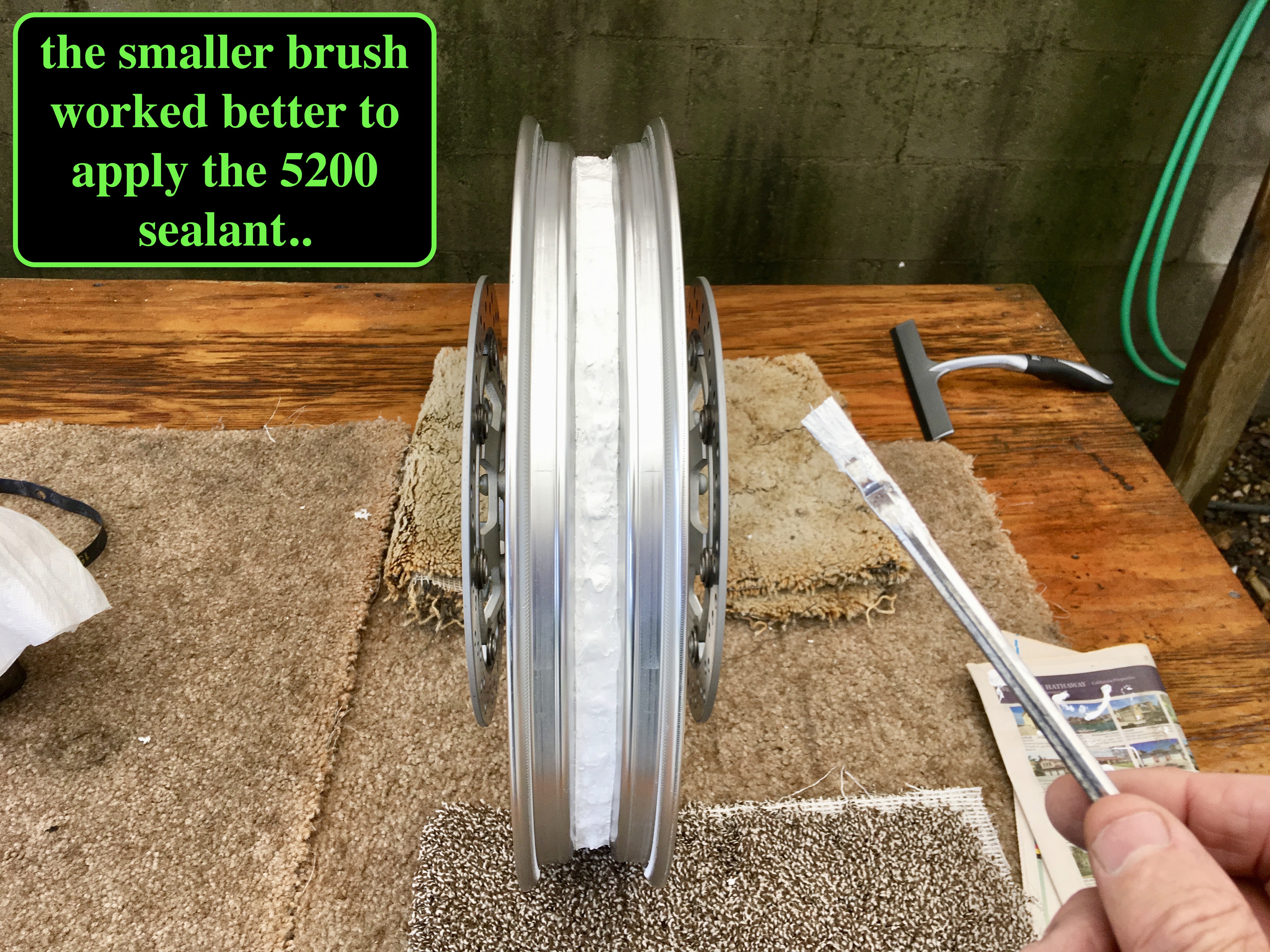
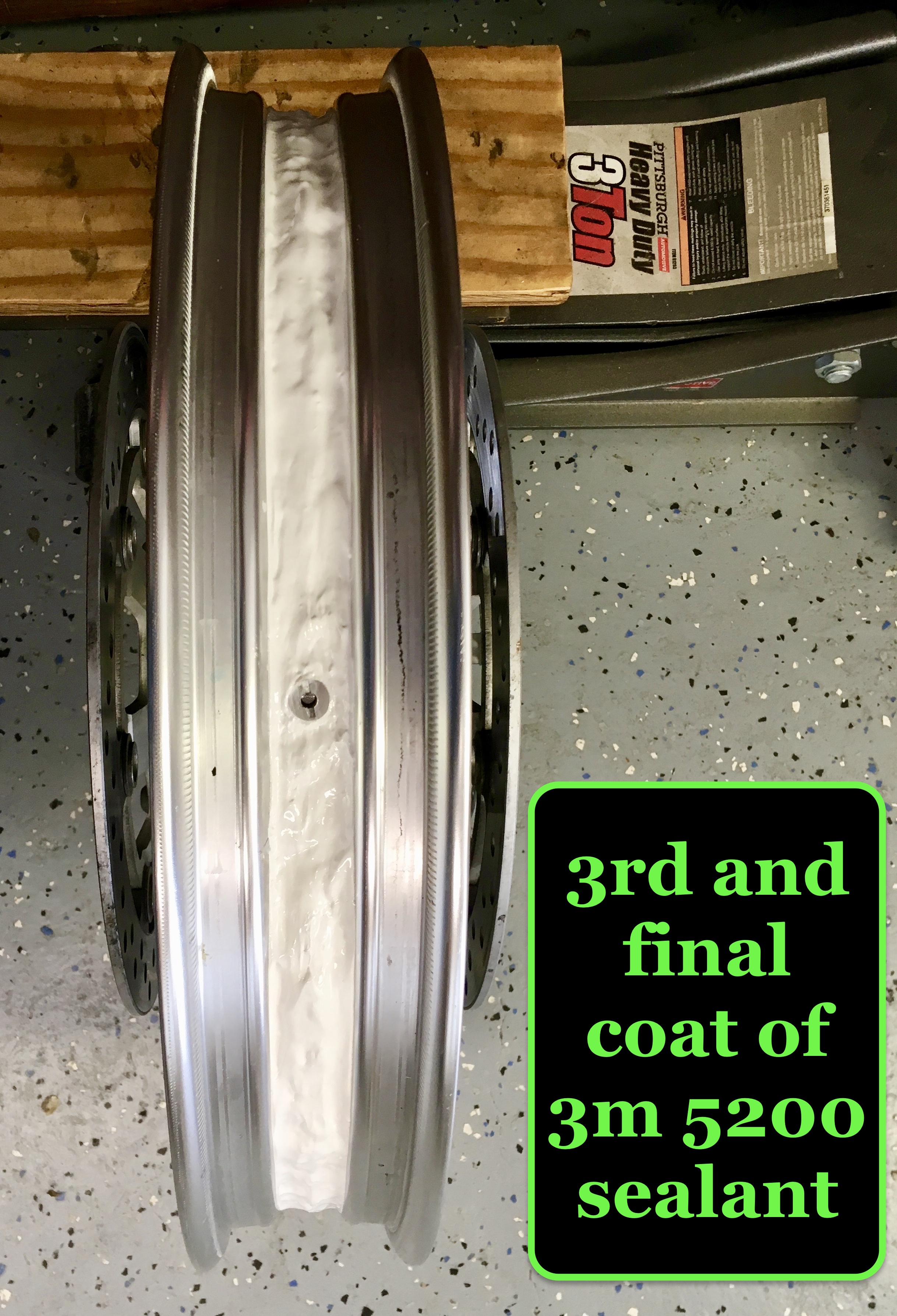
I have had a lot of older goldwings with spokes and haven't had much of a need to tighten spokes.. maybe I live in a dream world.. I have gone through quite a few tires on my little cb and for the first few times, have added another coat of 5200 sealer.. I now have 3 coats on both front and rear rims.. I had seen the video where the guy uses the tape and chose to go with the 3 coats instead.. my plan for tightening spokes if needed would be to adjust them at the time of tire replacement.. then re-seal the adjusted spokes or add another layer all the way around.. hard to say, until one examines the adjusted spoke nuts from the inside, as they are adjusted.. one thing for sure, if you use my method, be sure to do 2 coats initially.. I started with only one and found Leakes do to one or two tiny bubbles that I didn't notice..

.
b00681edcef496017da00eb7582ed0e6.jpg

.
5a81ab49c8bc62408ca843878fcbd873.jpg


..testing for air Leakes and I found them.. that was after I applied only one coat..
501b03f09fef1b5ca2105b485777c9d8.jpg

I get free mounting and balancing where I buy my tires so, I ask them to just remove the old tire, telling them I will return in a few days to have them mount and balance the new one.. I take the rim with me and do the 5200 sealing.. when I had the leaks on the rim with only one coat, I took the tire back in to the dealer and had them remove it.. then back to my shop again for another coating.. they charged me for the second mounting, which is understandable ..
it's not a good idea to use inner tubes in tubeless tires.. there can be chaffing and a build up of heat
 
I just installed the FOBO 2. It's pretty slick! I especially like the feature that tells you what your tire pressure would be if the air inside the tire was 70 degrees fahrenheit.
 
here we have yesterday's FOBO data.. it looks like the batteries are diminishing in charge at a predictable rate.. it would be nice if I could make it to their one year anniversary date before having to replace them.. it is interesting to see the tire temps and pressures change ..

chuckk ..

.
2e4d4930750148929e40c9d7f30abcd0.jpg
dc8ab14cebd24a9215001d1c68c36dbe.jpg

.
3c0abe7f1086585a22e50b62d1dff5ad.jpg
 
Back
Top