Bike crank but wouldn't start.

zirconxi_imp

Running like a top
Thread starter
Hi all,
3 days back i left my bike park outside in the rain. After the rain stop i rode the bike to fill up some gas and took her for a short 10km ride to dry up. Once home its been parked under roof. Today when i try to fire her up, she give me crank but just wouldn't start. I place my hand over the exhaust and can feel the air pulse. When key turn to on, have the usual fuel pump priming. Could it be bad gasoline or injector clot due to rain water?
 
Thread starter
Well, i did further investigation and more question pop up... the bike doesn't have sparks, and no fuel injected as well...the spark plug i pulled are all dry, and when i hookup a sparkplug to the cable and crank it while touching the cylinder head, no spark. or did i do it wrongly?? Any possible solution?
 
A bad battery can crank a bike. But if the voltage is dropping too low the electronics won't work.

If you put a multimeter on the battery, what does it read? Now, what does it read when cranking?

Max will write a dissertation on this. :P :D
 
Hi Popgun, i'm in deep thought at the moment, if the bike cranks at a normal pace the battery is fine, if it is slower to crank there may not be enough energy left to produce a spark.

Zi, do the; cel, hiss and eot lights come on in the top left corner of the indicator panel for a second and then go off again? if they do the ecm is doing it's normal startup routine and the fuses etc are ok.

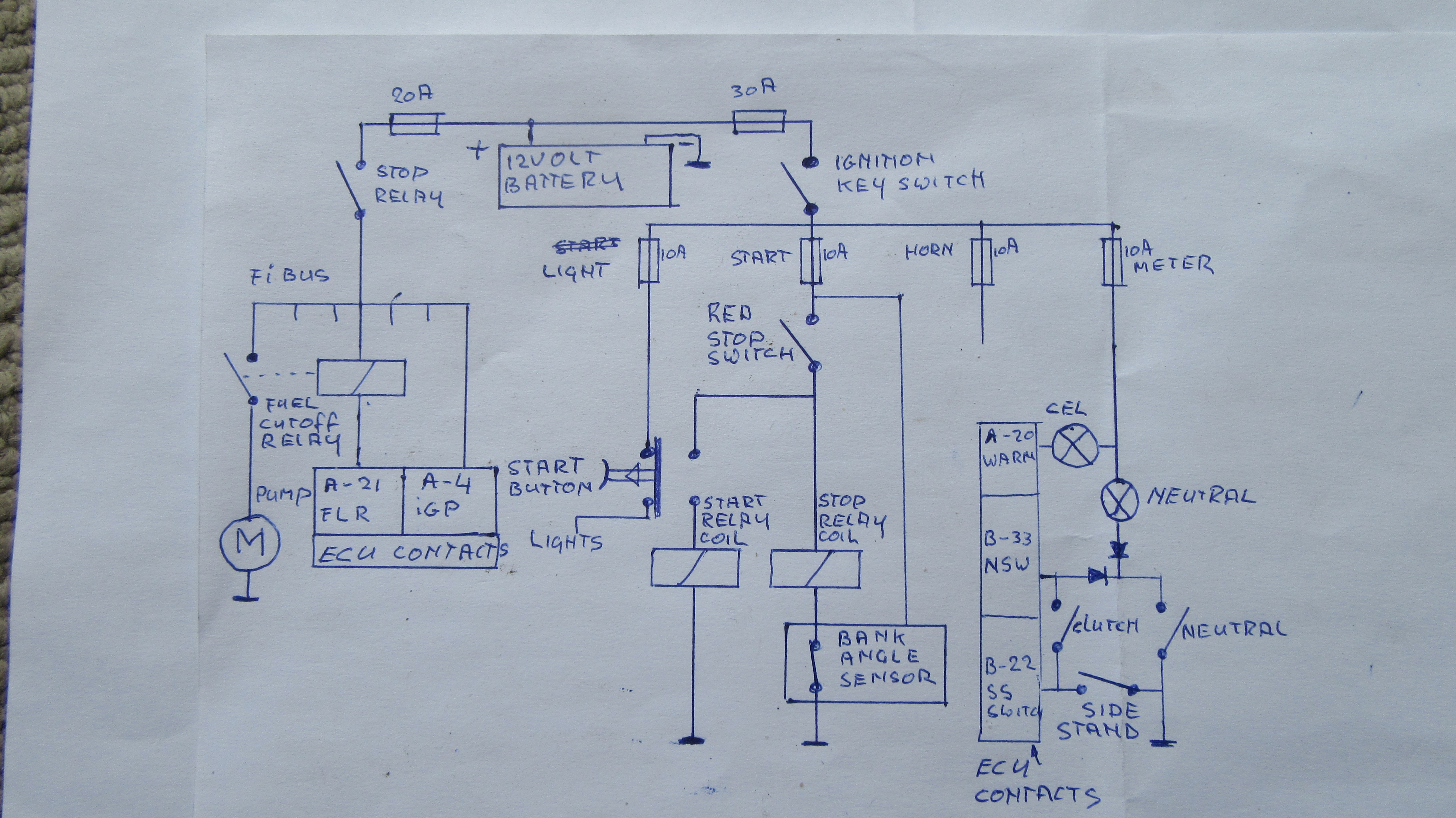
The coil, injectors and ecm all get their 12v supply from the "engine 12v buss", there are 10 black/white wires connected together and one of them is the supply coming from the engine stop relay, the buss is located under the fuel tank.

Here is a drawing that may help;
cd39f888ace261c6213cc8402671454c.jpg


You would know that there are only two coils for 4 cylinders so only one sparkplug can be tested at one time whilst the other side is still connected to it's sparkplug, as you may know it takes the ecm two full rotations to "discover"which is the correct cylinder to fire up, it has no way of telling which cylinder the crank sensor wants to ignite and that takes a bit of "hit and miss" to work that out initially.

If the ecm cannot detect a signal from the crank sensor it is unable to determine the timing and therefore won't fire or inject fuel.
The crank sensor is on the right hand side of the engine , exits at the top of the cover and you may be able to see it with the timing cover inspection screw removed ( the big aluminium one with the hex nut that can be screwed out ), i would have a look inside and look for moisture.

The crank sensor is a "reluctor" type with a white and a yellow wire, i am guessing the signal is small and sensitive.

Not sure if there is a fault code for this sensor if it fails but you can try to unplug the connector with the white and yellow wires and see if that creates a fault code, i think it is behind the right side cover.

Another test is to remove the spark plugs to make the engine crank easier and see if the tachometer comes off the stop when you crank the engine and reads slow rev's, it gets it's information from the crank sensor through the ecm, so if there is a small deflection on the tacho the sensor would seem ok.

Water in the fuel is possible but very unlikely, the tank filler cap has a good seal and water is unable to get past it.

If you have a spark it may be an idea to spray some carb cleaner or similar combustible mist into the air cleaner intake and see if that fires the engine.

I hope some of the hints may help you to understand what keeps the bike from starting up.

 
Pdedse makes a good point, it also would be worth a "throttle reset" ;
Turn the ignition on, wait for the meters to sweep and the fuelpunp to prime and then twist the throttle to fully open, close again and fully open again, switch off and try to start again.

No idea if this would work but it's easy to do and it might work.

As far as i know a full open throttle is used to clear or "evaporate" a flooded engine and normally inhibits fuel and ignition to allow the overfuelled engine to reset, somebody with better knowledge please correct me.
 
It would be very essential if Zi ( or others in the future) provided his CB's year/model and if equipped with HISS (Malasia, immobilizer????) system, but this basic information is missing. We know has no fuel, no spark.

Mentioned kill/engine stop switch is not an issue in this case, cause if it were, starter motor would not work at all, but it does, as stated by Zi. This circuit ++.. provides B+ to starter relay coil++...

Sorry to tell, but I would never squirt any WD40 on ignition wires/coil.
WD40 is flammable and when ignition wires are popped off, it creates even more flammable/dangerous situation due to arcing and direct contact with it.

If checking for spark and/or fuel, I would first check for spark, while fuel system is still "sealed off", then disable ignition = no spark, and as a last step, check for fuel.
You may also keep all s/pugs in place, disconnect 1 or more ign cables, insert "5th" s/plug into ign wire(s), crank over to check for spark.

Don't play with spark and "open" fuel system = flame danger.

MAX, as always, provides excellent pre-diagnosis.

This is not to offend or lecture anybody, but to give safe, friendly and practical advice.:)
Correct me if I am wrong, please.

:beerchug:
 
My 2001 Ford F-150 refused to start but would turn over. Called my dealer service dept and the tech told me that it was a defective throttle position sensor and to hold the throttle to the floor and try it. Started immediately. Replaced the sensor to fix.
 
redbirds_imp said:
My 2001 Ford F-150 refused to start but would turn over. Called my dealer service dept and the tech told me that it was a defective throttle position sensor and to hold the throttle to the floor and try it. Started immediately. Replaced the sensor to fix.
Yes, your tech is correct in this case.
TPS normally operates from 0.2v to 5.0V, low voltage = less fuel, 5V = wide open throttle and more fuel needed.
In case when throttle is closed or almost closed (depending on system) and TPS, due to its fault, sends higher than required signal/voltage to ECM, let's say 4.0V, fuel excess will flood your plugs = difficult or impossible to fire up. Keep in touch with this good tech.
:)
 
Thread starter
Woke up in the morning and found so many reply from you guys.. really great help of you guys.
Here is a little extras infor, bike is a 2013 model (direct JDM), HISS equiped (How to check if HISS is not the culprit ??), 36000km travelled, no cold weather, only rain, hot sun 20-40 Celsius.
On key turn to on, all pre-checks lights and meter swipe work, everything dimmed afterward except the oil pressure and neutral are lit after check. Key turn off, the hiss will blink, but once key turn on, it no longer blink.
Crank with throttle 1/8, 1/4, 1/2 open tried, TPS reset tried. Tried the "5th sparkplug", no spark during crank. Pulled plug out and it dry. Engine stop switch if is in kill position, the oil overheat lights will be on. But once in run position, its off. Tried crank with clutch pulled in no go (a friend recommend this).
Will try to get battery voltage once i got my hand on a digital voltmeter. My analog meter can't catch the fluctuation during crank.
Crank sensor not check yet (involve opening up engine will be last), maybe will try on changing the battery 1st as its had been in service for 3 years plus. Anyway, its long holiday season soon here in Malaysia and I am preparing for a long holiday. The bike will have to wait till the festive season is passed before I will work on her...
 
Zirconxi thanks for doing all these tests, what you mention sounds all exactly correct and thanks for the feedback.

To your question; if hiss is not happy the fuelpump etc will not pressurize at startup as usual, so all is fine with hiss.

To confirm hiss function; make a shield for the key from alumunium foil big enough to cover the hiss coil which is the plastic piece around the ignition key with "start"etc. written on it and stick the key through it and try to start, all the lights and the meters work but the fuelpump does not prime the engine, it is controlled directly by the ecm ( pin e-21 see diagram above );


After so many starts it appears the battery is still holding up, i would charge the battery up before going any further.
This will do two things; it restores the battery capacity to do further tests and;
It will give the ecm a possibility to go back to a "refreshed state" whilst the battery is disconnected and set it's bits in memory to day one ( my assumption).

I find it hard to believe anything is broken and the ecu seems to be functioning as before, no fault codes are set so it appears all parts are passing the startup tests but it cannot decide where the crank is based on the lack of spark and thanks for testing that again.

Hope you have a good holiday and we are all here if you need some more help:thumbsup:
 
Thread starter
Hi all, I am back from holidays. 1st thing i do is try to start the bike again. This time, with a digital voltmeter.

Key turn off: 12.3v
Key turn on: 11.8v
On Crank: drop to 8v, then 7v.
Released crank: 11.8v

So is this confirm the battery is dead?
 
Thanks for the test, especially the last value of 11.8 volts should be a bit higher.

To compare with my 3 year old battery;

1; float with ignition key off: 12.75v.
2; key on: 12.35v.
3; cranking: 10.20v.
4; float after start, key off: 12.45v.

Another clue is the neutral light, i found if it stays on DURING CRANK the battery is usually ok, can you have a look for me if your neutral light goes out when you crank? i would like to know.

If you don't have any jumper cables to assist in starting it may be time to invest in a new battery, not conclusive but in your case suspect.
It could explain the lack of spark which otherwise has no good reason to be defective, hope this helps.
 
Back
Top