
Dealing with a stuck JIS screw

Stichill

Road warrior
Thread starter
Went to bleed the brakes on my CBR250R and one of the cover screws wouldn't budge, even using the proper JIS screwdriver. It started to cam out and displace metal in the screw head.

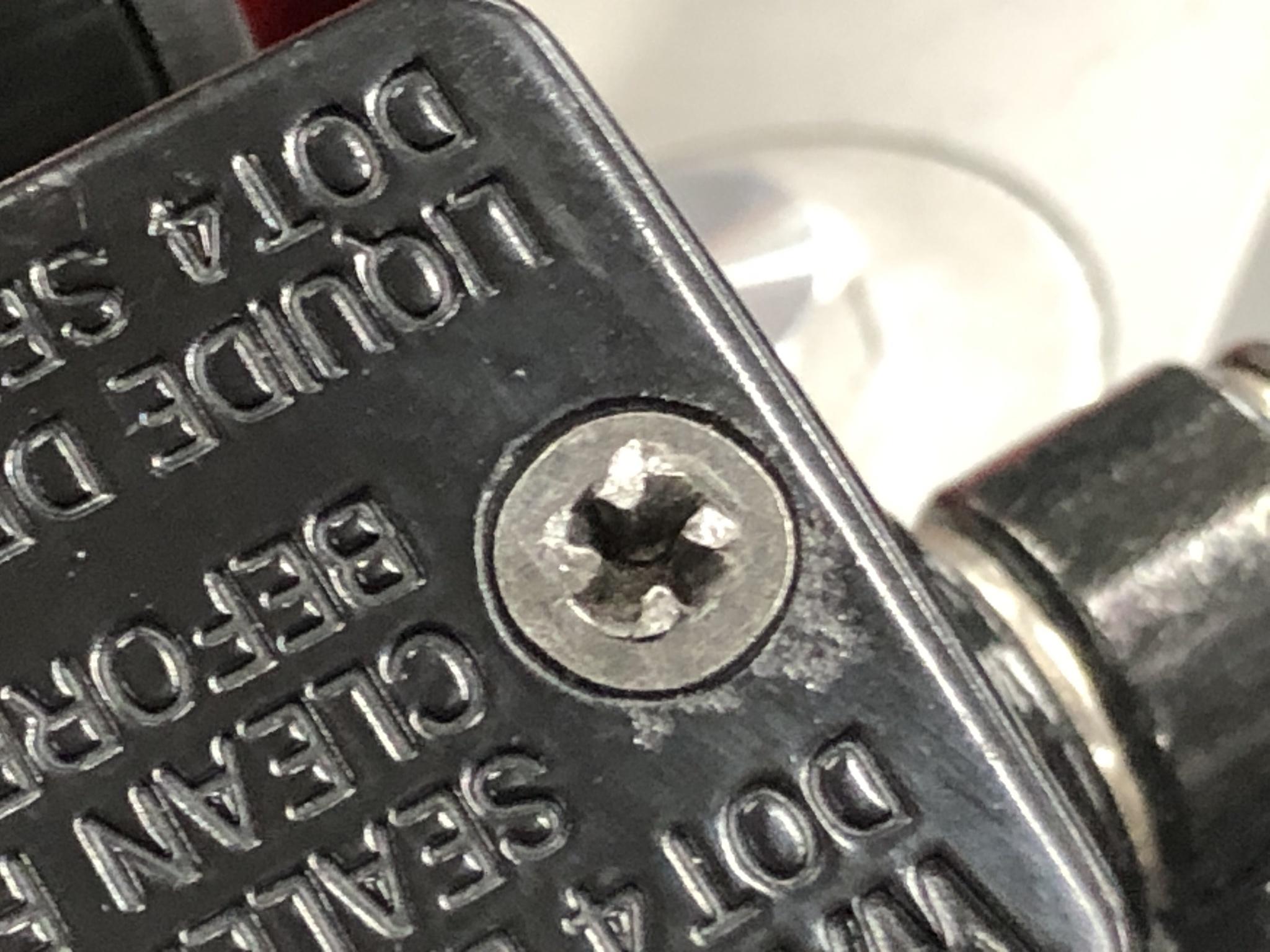
I decided to get a ball-peen hammer and carefully beat the protruding metal back down into the screw head. This made the screwdriver fit very tightly and I was able to break the screw loose by momentarily turning it clockwise and then counter-/anti-clockwise.

This is the screw after I loosened it:
c63b8054c089224357f43d54073f8527.jpg


Looks like there's some galvanic corrosion happening between the screw and the cover, so both will be replaced with new + a small amount of anti-seize compound.

This method was less scary than a drill and a tiny back-out, and saved the master cylinder itself from being damaged.
 
Stichill_imp said:
Went to bleed the brakes on my CBR250R and one of the cover screws wouldn't budge, even using the proper JIS screwdriver. It started to cam out and displace metal in the screw head.

I decided to get a ball-peen hammer and carefully beat the protruding metal back down into the screw head. This made the screwdriver fit very tightly and I was able to break the screw loose by momentarily turning it clockwise and then counter-/anti-clockwise.

This is the screw after I loosened it:
c63b8054c089224357f43d54073f8527.jpg


Looks like there's some galvanic corrosion happening between the screw and the cover, so both will be replaced with new + a small amount of anti-seize compound.

This method was less scary than a drill and a tiny back-out, and saved the master cylinder itself from being damaged.
You are reinforcing my strategy of keeping bikes for a max of 4 years or 20K miles.
 
There is a product called : Drive Grip , this will increase torque when removing stuck screws . Product Vibra-Tite 47002 . I only used it once and it did work well .
 
Next time try an impact driver.

stick it in, give it a twist and smack it with a hammer
 
I agree, I probably would have tried an impact driver, though with a very light hammer. Glad you got it resolved.
 
Vessel even has an impact JIS screwdriver.
 
Thread starter
New parts are cheaper than new bikes. Plus I like this one a lot and they don’t make them anymore (much like the CB1100). Assuming a 4-year replacement interval, all US CB1100s would need to be retired by their original owners by now.

No-go on the impact driver attempt before this solution. It didn’t work and was stressing the master cylinder (risked shearing the locating pin on the handlebar).

I’ll look into Drive-Grip, Houtman. Another idea I have going forward is stainless steel hex head screws.
 
Stichill_imp said:
New parts are cheaper than new bikes. Plus I like this one a lot and they don’t make them anymore (much like the CB1100). Assuming a 4-year replacement interval, all US CB1100s would need to be retired by their original owners by now.

No-go on the impact driver attempt before this solution. It didn’t work and was stressing the master cylinder (risked shearing the locating pin on the handlebar).

I’ll look into Drive-Grip, Houtman. Another idea I have going forward is stainless steel hex head screws.
wow.... "back in the day" we used an impact driver all the time on stuck engine case screws.
rickcb_imp said:
Stichill_imp said:
Went to bleed the brakes on my CBR250R and one of the cover screws wouldn't budge, even using the proper JIS screwdriver. It started to cam out and displace metal in the screw head.

I decided to get a ball-peen hammer and carefully beat the protruding metal back down into the screw head. This made the screwdriver fit very tightly and I was able to break the screw loose by momentarily turning it clockwise and then counter-/anti-clockwise.

This is the screw after I loosened it:
c63b8054c089224357f43d54073f8527.jpg


Looks like there's some galvanic corrosion happening between the screw and the cover, so both will be replaced with new + a small amount of anti-seize compound.

This method was less scary than a drill and a tiny back-out, and saved the master cylinder itself from being damaged.
You are reinforcing my strategy of keeping bikes for a max of 4 years or 20K miles.
:rofl: 20K isn't even ONE good year's worth of riding (doubt I'll make that this year although I'm already over 5K)
 
A countersunk bolt has a lot friction under the head, specially if it hasn't been loosen for a while. A drop of wd-40 on the perimeter would've helped.
 
Stichill_imp said:
Went to bleed the brakes on my CBR250R and one of the cover screws wouldn't budge, even using the proper JIS screwdriver. It started to cam out and displace metal in the screw head.

I decided to get a ball-peen hammer and carefully beat the protruding metal back down into the screw head. This made the screwdriver fit very tightly and I was able to break the screw loose by momentarily turning it clockwise and then counter-/anti-clockwise.

This is the screw after I loosened it:
c63b8054c089224357f43d54073f8527.jpg


Looks like there's some galvanic corrosion happening between the screw and the cover, so both will be replaced with new + a small amount of anti-seize compound.

This method was less scary than a drill and a tiny back-out, and saved the master cylinder itself from being damaged.
I replaced the phillips screws on my reservoir covers with star-pattern screws I got off ebay. They work a lot better. Tighten easily and remove without stripping. If you are interested I can find the seller on ebay.
 
Good point Joe, and Stitchill i apply a heavy grade grease to the inside of the lids especially in the seams and screws for that reason and wipe the excess off after, there are usually some condensated droplets under the lid, it is exposed to air to allow the membrane to adjust for deminishing fluid level due to brake pad wear.
Also don't over tighten the lids, they deform and create a gap for the fluid to creep out and go to work on the metal bits,
Good work on the jis driver sir, only ones that i have is on my vessel impact driver, had it for ages and with perfect results.
never had any stuck screws in a long time, sometimes you have to " assist "the design by good maintenance, not doubting your skills but having grease in important places ( most bolts ) extends their service life, grease is cheap but messy to work with but paper towels clean fingers very well, still nicely saved screw, could have been a lot worse.
The other overlooked place is under the boot on the back of the piston, if not greased it can create a mess with escaped traces of fluid in the circlip area.
 
Thread starter
LakeWylieJoe_imp said:
The brake/clutch fluid is supposed to be bled/replaced every two years. Has that cover ever been off before?
Oh yes. I have speed bleeders and do this once a year.
michael1954_imp said:
Stichill_imp said:
Went to bleed the brakes on my CBR250R and one of the cover screws wouldn't budge, even using the proper JIS screwdriver. It started to cam out and displace metal in the screw head.

I decided to get a ball-peen hammer and carefully beat the protruding metal back down into the screw head. This made the screwdriver fit very tightly and I was able to break the screw loose by momentarily turning it clockwise and then counter-/anti-clockwise.

This is the screw after I loosened it:
c63b8054c089224357f43d54073f8527.jpg


Looks like there's some galvanic corrosion happening between the screw and the cover, so both will be replaced with new + a small amount of anti-seize compound.

This method was less scary than a drill and a tiny back-out, and saved the master cylinder itself from being damaged.
I replaced the phillips screws on my reservoir covers with star-pattern screws I got off ebay. They work a lot better. Tighten easily and remove without stripping. If you are interested I can find the seller on ebay.
Definitely, yes that would be far superior. Thank you!
max_imp said:
Good point Joe, and Stitchill i apply a heavy grade grease to the inside of the lids especially in the seams and screws for that reason and wipe the excess off after, there are usually some condensated droplets under the lid, it is exposed to air to allow the membrane to adjust for deminishing fluid level due to brake pad wear.
Also don't over tighten the lids, they deform and create a gap for the fluid to creep out and go to work on the metal bits,
Good work on the jis driver sir, only ones that i have is on my vessel impact driver, had it for ages and with perfect results.
never had any stuck screws in a long time, sometimes you have to " assist "the design by good maintenance, not doubting your skills but having grease in important places ( most bolts ) extends their service life, grease is cheap but messy to work with but paper towels clean fingers very well, still nicely saved screw, could have been a lot worse.
The other overlooked place is under the boot on the back of the piston, if not greased it can create a mess with escaped traces of fluid in the circlip area.
I'm a big user of anti-seize for most bolts that are prone to sticking, which are usually the larger ones that aren't removed often. It's a bit unusual for small screws like this to seize. I think it's the large surface area under the head that forms a bond which can't be overcome by the rather weak JIS crosshead. (Edit: I see that jtopiso agrees.) I saw the ball-peen method of screw rehabilitation on a gunsmithing channel. It's very common for people to use the wrong type or size of slotted screwdriver on gun screws, and end up damaging the screw slots. It would be tempting to file off the displaced metal, but the integrity of the screw is better preserved by lightly tapping the metal back into place with a polished ball-peen hammer.
jtopiso_imp said:
A countersunk bolt has a lot friction under the head, specially if it hasn't been loosen for a while. A drop of wd-40 on the perimeter would've helped.
Good point. It was a surprise to me that this one was stuck. The other one loosened without incident.
 
max_imp said:
Good point Joe, and Stitchill i apply a heavy grade grease to the inside of the lids especially in the seams and screws for that reason and wipe the excess off after, there are usually some condensated droplets under the lid, it is exposed to air to allow the membrane to adjust for deminishing fluid level due to brake pad wear.
Also don't over tighten the lids, they deform and create a gap for the fluid to creep out and go to work on the metal bits,
Good work on the jis driver sir, only ones that i have is on my vessel impact driver, had it for ages and with perfect results.
never had any stuck screws in a long time, sometimes you have to " assist "the design by good maintenance, not doubting your skills but having grease in important places ( most bolts ) extends their service life, grease is cheap but messy to work with but paper towels clean fingers very well, still nicely saved screw, could have been a lot worse.
The other overlooked place is under the boot on the back of the piston, if not greased it can create a mess with escaped traces of fluid in the circlip area.
As long as it is not general purpose Lithium Grease, that is not good for rubber. You would want to be using a rubber friendly silicon grease or similar.
 
I put a the screwdriver in place, put some loosen torque on it, and tap the end of the handle with a ball peen. It transfers the shock into the screw and breaks the "set". For really stuck ones, put a few drops of WD on it, let it sit overnight, and do the ball peen thing.
 
I think michael1954 has the best solution, an Allen or Torx counter sunk head screw of the correct metric size in steel. I have used stainless in a few places, but when I do, am careful to use a sparing amount of anti seize on the threads. I dont think I would use stainless in this application because not only can stainless gall, causing the fastener to seize, but also because stainless alloy has lower torque and shear specs than steel. I would be interested to see the eBay listing michael1954 used for his screws.
 
Thread starter
2017EX_imp said:
I think michael1954 has the best solution, an Allen or Torx counter sunk head screw of the correct metric size in steel. I have used stainless in a few places, but when I do, am careful to use a sparing amount of anti seize on the threads. I dont think I would use stainless in this application because not only can stainless gall, causing the fastener to seize, but also because stainless alloy has lower torque and shear specs than steel. I would be interested to see the eBay listing michael1954 used for his screws.
How much torque and shear strength does it really need to retain a cover?

Galling tends to be a problem with similar metals in contact with each other. As long as one is harder than the other, galling shouldn’t be an issue.
 
Back
Top