Clock

Cormanus

Administrator
Staff member
Thread starter
Can someone tell me how the clock retains its memory when the ignition is switched off?

My clock has started resetting to 1:00 after the ignition has been off for a day or so. It's not lack of charge in the battery as I've just installed a new one which is showing 12.9v on the meter. Earlier in the year I had the instruments off the bike as ants had somehow nested in there, but the other instruments are working fine, so I find it hard to believe there's a poor connection.

Any thoughts would be very welcome.
 
For my Cb1100EX, the clock is powered by the battery. If your motorcycle clock frequently resets, it may indicate that your new battery is losing voltage and may need to be replaced. I suggest you have your battery teated to rule out that possibility. David
 
Agree with David statement.
Also check for dark current, aka parasitic draw, which is between 20 to 50 mA =  0.020 - 0.050 A.
May have to wait a few minutes to get the proper reading after the ignition is OFF. All you need is a basic multimeter.
...or intermittent open circuit to the clock

mA = miliamps
A = amps
1000 mA = 1 A
 
Thread starter
Thanks rdprdp01 and peterbaron. I have a basic multimeter. Can you tell me how to connect it to test for parasitic draw? I have to find a wire to the clock and bridge it with the multimeter? Is that right?

In other tests, the battery shows:

12.84v at rest
12.39v when the ignition is turned on
10.62v when cranking
13.96v at idle
13.06v immediately after stopping.
 
Thread starter
I disconnected the positive lead from the battery and put the multi-meter across the terminal and the wire with the ignition off. I got no reading on any of the settings. As I turned the dial to a new setting there was a momentary reading which immediately disappeared.
 
Your multimeter has to be set to amps/A, in order to get a proper reading....I always disconnect the negative terminal., safer than the positive.

Simple test: there is a 10A clock/turn signal fuse in the fuse box undter the seat = pull it out, check for moisture, contamination, corossion, whitish marks/powder,  inspect and clean if needed, or/and replace the fuse.. it may have poor conntact due to age.

By looking at the battery voltage results and especially when cranking and before the ignition is on/at rest, I don't think you have a battery issue or parasitic draw.
You never mentiond about slow or no crank, correct?, so at this moment I would refrain from doing a parasitic draw test.
Also, the clock has so minimal draw that your battery has to be in a very bad state = so far no sympthoms as per your statement.

The ants issue you previously had, taking the cluster apart or/and disconnecting the connectors could be your problem. You may have to recheck the connectors that were involved during your repair.
When the clock reset itself do you see any fragments missing from its digital display or always show good and complete like 1:00 ?
You said: My clock has started resetting to 1:00 after the ignition has been off for a day or so...what is the battery voltage reading when the clock shows 1:00, ignition is on after a day or so, but before cranking?
Does the clock reset during cranking only or is already reset when the ignition is on?
 
Thread starter
Thanks peterbaron. Tomorrow I'll check the fuse. On Monday I rode the bike. The clock showed 1:00 when I turned on the ignition and before cranking. I set the clock. On Tuesday I switched on the ignition and the clock was fine. This morning (Wednesday) I switched on the ignition and the clock again showed 1:00.

No problem cranking. The Neutral light stays on while cranking.

No fragments are missing from the clock display.
 
When the clock resets to 1:00, does the trip meter also reset?  Both run on a separate circuit that does not run through the ignition switch, accounting for some of the parasitic draw the bike has.  If the tripmeter does not reset, I would guess a connection problem.
 
Thread starter
Thank you, pekingduck and LucienLeFranc. The trip meters are not resetting.
 
Thread starter
It's a 2011 model. There's a 10A fuse for the clock and the indicators. Same as the wiring diagram in the 2013 service manual.
 
Updated post

This clock has very simple circuit. I used 2013-2014 service manual for CB1100 ('13 model) non-ABS electrical diagram as per p. 20-2

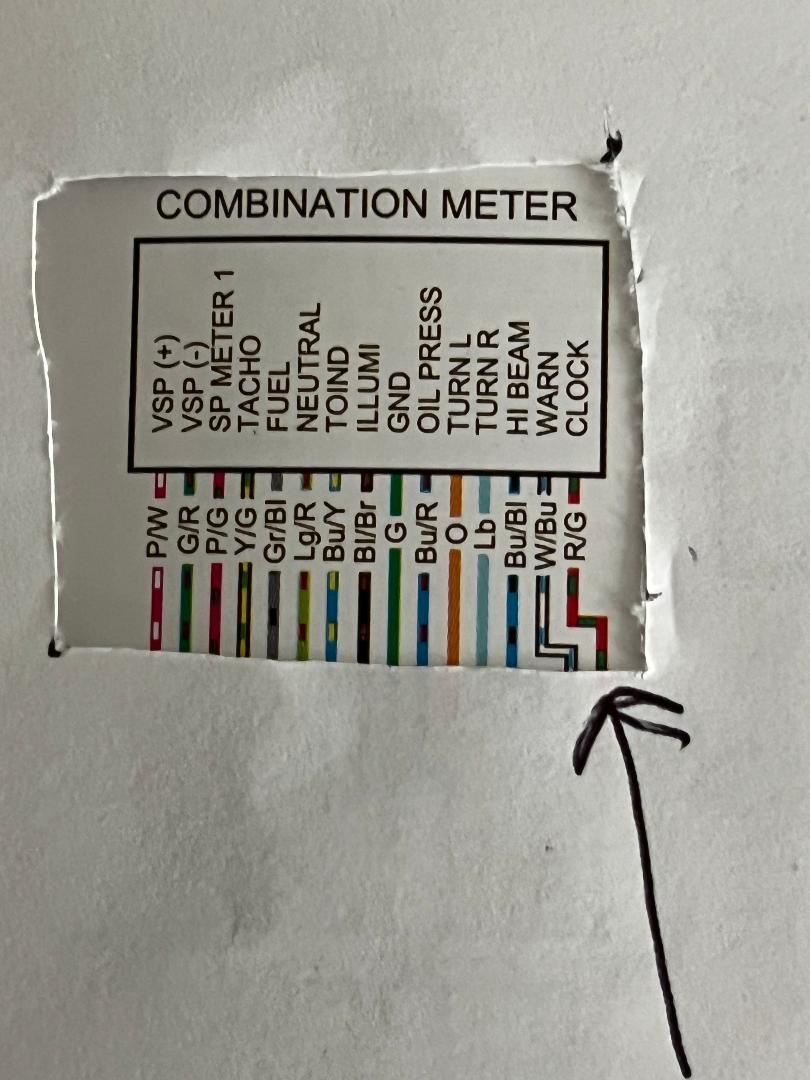
1. at the meter/cluster - 15/multi-pin conector (based on electrical diagram/pic)** - R/G* wire goes through 6P connector to the 10A - E fuse in the fusebox, then it changes colour to R and it splits to the ognition sw and regulator/rectifier.
2. ground must be common for the meter/cluster but I do not think is the issue, however it's possible if the cluster's printed circuit is a hair cracked....or..

I would check for an intermittent poor connection by recheckig the cluster-15 pin** & 6P & E-fuse connections, by simply disconnecting, inspecting, cleaning/or other proper action.
I think the issue is present when (the bike) and connectors cool down, shrink and momentarly make poor contact to the clock circuit... then everything warms up, expands and all is is back to normal again....or during the voltage spike, the moment when the ignition is turned ON....
Use magnified glass to inspect.
Very common issues in automotive.

*R/G - there is only one R/G wire of this colour at the cluster 15-pin** connector and is easy to be located, as it sits at the connector's end/corrner.. 
The Red/Green wire should have B+ at all times/memory, even if the ignition is off
There is an P/W wire on the oposite end of that connector,**, see pic. 
6P connector is located in the head lamp bucket at 12 o'clock and is a 3 row x 2 pin connector.
The multi-point/15-pin** connector directly connects the cluster printed circuit.
You shuld have no problem finding, indentifing connectors due to your previous "ants" investigation
** the single 15 pin to meter/circuit board connector as per p.20-2 might be a double one of 6 & 9 space combination as per p. 19-12 of the said service manual
Here is the link that clarifies the cluster sub harnes issue, part # 5 - 2 to 2 end connectors.
https://oem-bike-parts.com/en/parts/honda/1100cc/cb-1100/cb1100b-cb1100-2011/f-2-meter
Here is a video clip for even further and visual clarification:
I hate how Honda names, numbers  and indicates their connectors and pin locations in this service manual.

VzZJ5An.jpg


The CB1100 Community Forum
 
peterbaron and Cormanus, I wonder if shop manuals for US models are the same as for Canada and other countries. since the US did not have the model until 2013.  My infor is from US manual.Any thoughts?

Anyway, my 2013-2017 manual shows only a 10 pin and a 6 pin connector connector to the meter cluster.  In the instruments service portion of the manual, it refers to the backup voltage power line check as Peter describes, coming off the 6-pin connector and going straight to the unswitch regulator side of the battery and goes directly to the turn signal and clock fuse, which is fuse E on non-ABS, and F on ABS models, and fuse G on 2014-2017 models.  

That power, as stated, should be on all the time to power the clock and the temporary memory circuit for trip mileage, and comes from the regulator side of battery power, not the ignition switch side.
 
pekingduck said:
peterbaron and Cormanus, I wonder if shop manuals for US models are the same as for Canada and other countries. since the US did not have the model until 2013.  My infor is from US manual.Any thoughts?

Anyway, my 2013-2017 manual shows only a 10 pin and a 6 pin connector connector to the meter cluster.  In the instruments service portion of the manual, it refers to the backup voltage power line check as Peter describes, coming off the 6-pin connector and going straight to the unswitch regulator side of the battery and goes directly to the turn signal and clock fuse, which is fuse E on non-ABS, and F on ABS models, and fuse G on 2014-2017 models.  

That power, as stated, should be on all the time to power the clock and the temporary memory circuit for trip mileage, and comes from the regulator side of battery power, not the ignition switch side.

Joe, I use 2013-14 manual. Cormanus bike is 2011, and I believe is non-ABS??

THANKS for bringing this to my attention...by mistake I mixed up an A-ABS  with non-A,  CB1100/'13 models... 
I corected my post #13 
:thanks:

P.S. The combination meter printed circuit board ass-y/15 pin.... and 6P (also 10P) in the head lamp bucket are linked together by a sub-harness, and I concluded this by studying p. 19-12 with pics & p. 20-2 electrical diagram of my 2013-14 manual.  As I read and view p. 19-22 the said 15 pin single connector might be a double type???, and they sit on top of each other. ELectrical p. 20-2 indicates a 15 pin as single - perhapps for simplicity, but p.19-12 says and illustrates connectors...
The circuit board connector or connectors cannot be seen unless the cluster ass-y is taken apart by splitting.

Here are some links that clarify the issue:
#5 sub harness with 2 to 2 end connectors:
https://oem-bike-parts.com/en/parts/honda/1100cc/cb-1100/cb1100b-cb1100-2011/f-2-meter
and a video clip :
 
Thread starter
The only half intelligent thing I can add to this is that my shop manual is the US version — I don't think there's an Australian one. It aligns with what I can see on the bike.
 
Is your bike ABS?, I don't think so.

You may not have an OEM Honda but a counterfit model... :)
 
Thread starter
Yikes! Fake or real it's not an ABS model. Honda didn't send them to Australia.
 
Thread starter
Thanks PB.

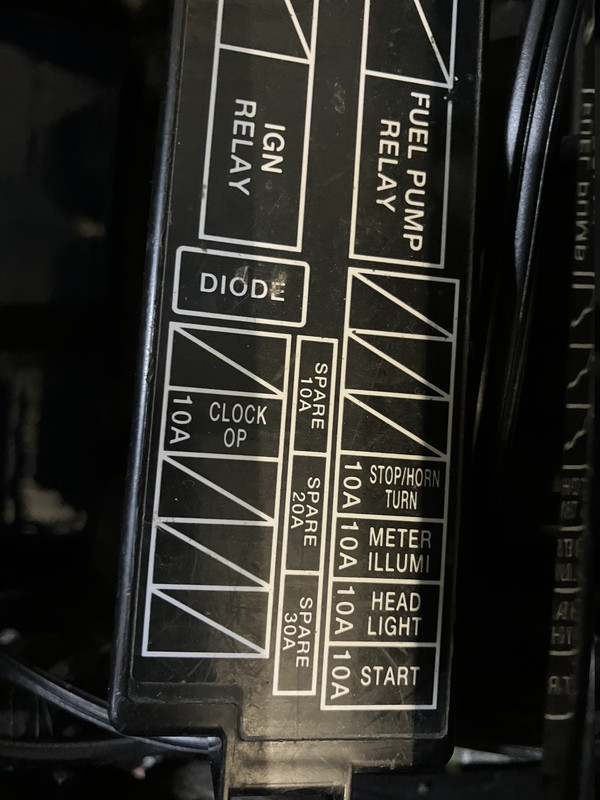
Interestingly, I think there's a slight difference in wiring on the Australian model. In the wiring diagram, Fuse E is for TURN/CLOCK. On my 2011 Australian bike, it's for CLOCK/OP. (What is 'OP'?) The turn signals are with the STOP/HORN fuse. The Australian bikes do not have Hazard lights. Do they work with the ignition off on US or Canadian spec bikes? I wonder if that's the reason? I've also noted that, with the fuse pulled, the clock still displays with the ignition on.


Further work is delayed for a day or so due to the removal of a couple of basel cell carcinomas from the back of my leg (one of the joys of ageing in Australia). It means I have to rest the leg and try to keep it elevated for a little longer.
 
Back
Top