Checking Drive Chain Slack

Townie_imp

Running like a top
Thread starter
Folks,

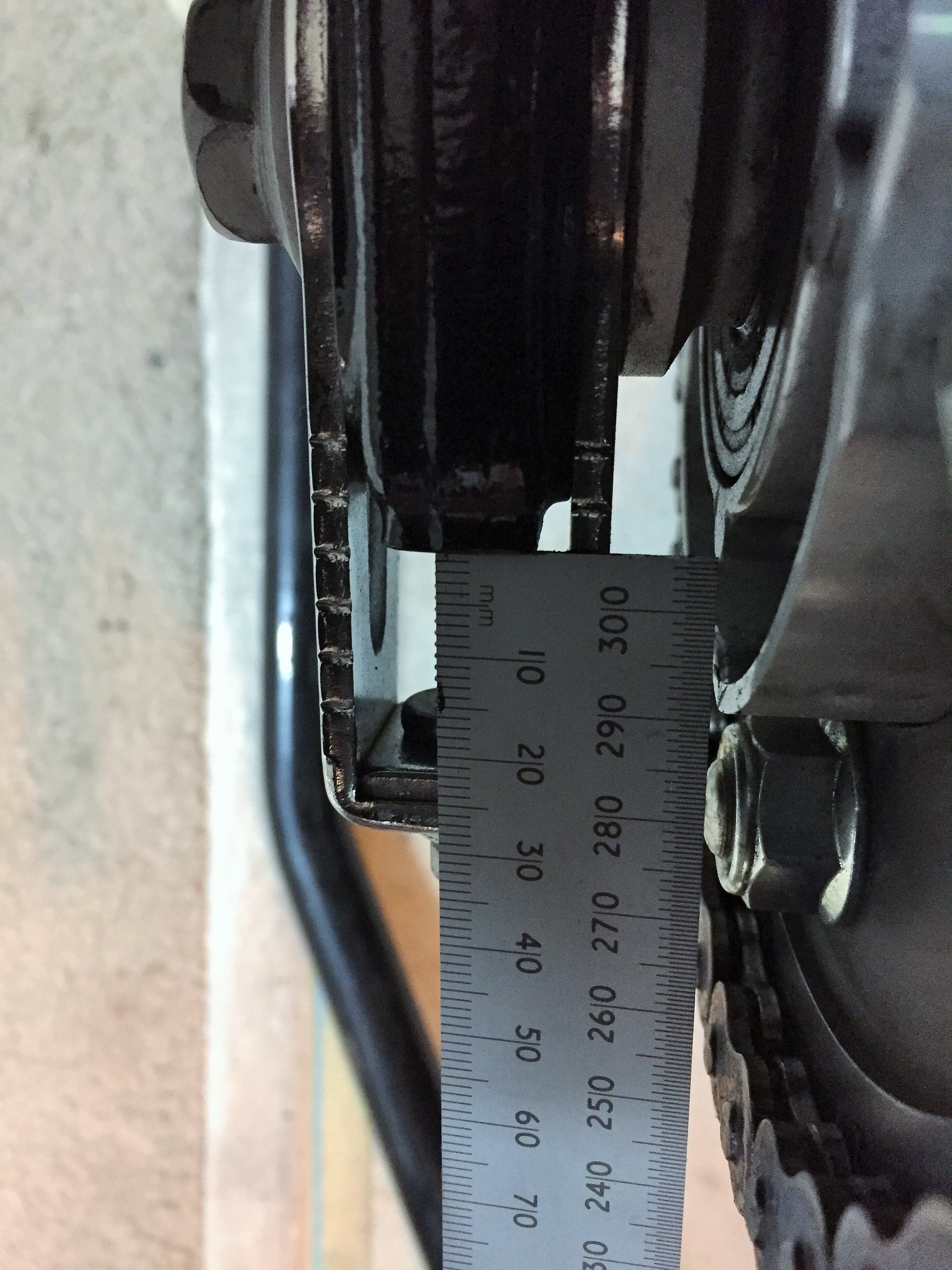
Hopefully an easy one for you. I'm checking my drive chain slack, using a vertical ruler roughly midpoint between front sprocket and rear sprocket. I'm measuring the deflection of the lower run. Bike is on the center stand, in neutral.

In measuring the deflection, do I:

A. Pull the lower chain run down as far as I can, then push it up as far as I can. The difference in measures on the ruler is deflection.
B. Push it up from its resting position, measure deflection.

The 2 procedures produce quite a different result, about 2" for method A, 1.25" for method B.

Thanks.
 
Over thinking this Townie. The sticker on the swingarm says to check the owners manual for instructions.

Since I don’t have it handy, I looked in the service manual. It shows your method B.

Check your PM.
 
Thread starter
Lord Popgun_imp said:
Over thinking this Townie. The sticker on the swingarm says to check the owners manual for instructions.

Since I don’t have it handy, I looked in the service manual. It shows your method B.

Check your PM.
I don't think I'm over thinking it. If the 2 methods produced a similar result, then I wouldn't be asking the question.One method says I'm in spec, the other doesn't.

And yes, I did check the manual. To me, it's ambiguous.

Here's a decent vid that suggests Method A is what should be used:

 
I use method A aiming for roughly 35 to 40mm of slack and double checking wheel alignment about 100 times before torquing up the axle.
 
Well, I really don’t care about videos, I go by the service manual. YMMV
 
How do you check the wheel alignment Aussieflyer?

Townie, I use method B, but I've seen method A used and have wondered whether it is actually correct.

Taking Aussieflyer's and my approach may end up producing a roughly similar result. Using method B, I aim for 25-30 mm of slack as my seat-of-the-pants assessonometer tells me the bike's smoother when the chain is tighter. What would that slack then be if I used method A? Possibly about what Aussieflyer aims for. If I used method A and went for 25 mm of slack, would I end up with a chain that was too tight?

Looking at the illustration in the owners manual leads me to the view that Honda recommends method B. Certainly, if I am aiming for 25mm slack I'd be more inclined to use method B.

Not sure that helps really.
 
Yamahas use method A. Yamaha manuals are clear. I ruined my wife's cbr500r chain in less than 10k miles assuming Honda also used method A, which kept the chain too tight. Hondas use method B.
 
Townie_imp said:
Lord Popgun_imp said:
Over thinking this Townie. The sticker on the swingarm says to check the owners manual for instructions.

Since I don’t have it handy, I looked in the service manual. It shows your method B.

Check your PM.
I don't think I'm over thinking it. If the 2 methods produced a similar result, then I wouldn't be asking the question.One method says I'm in spec, the other doesn't.

And yes, I did check the manual. To me, it's ambiguous.

Here's a decent vid that suggests Method A is what should be used:

I agree, it is ambiguous. It only says “Check the slack in the lower half of the drive chain midway between the sprockets.” It does not specify how to check the slack. In reading that I assumed you would push down then push up to measure the total slack.
 
Cormanus_imp said:
How do you check the wheel alignment Aussieflyer?

Townie, I use method B, but I've seen method A used and have wondered whether it is actually correct.

Taking Aussieflyer's and my approach may end up producing a roughly similar result. Using method B, I aim for 25-30 mm of slack as my seat-of-the-pants assessonometer tells me the bike's smoother when the chain is tighter. What would that slack then be if I used method A? Possibly about what Aussieflyer aims for. If I used method A and went for 25 mm of slack, would I end up with a chain that was too tight?

Looking at the illustration in the owners manual leads me to the view that Honda recommends method B. Certainly, if I am aiming for 25mm slack I'd be more inclined to use method B.

Not sure that helps really.
Just by measuring the axle position in the swing arm.
331bbb2db542f7b7536ff2c1ffd91821.jpg


I checked the accuracy of the adjuster blocks when I swapped out the mags for the wire wheels. Fitted the mags back on on the bike with no tyres and used a couple of long straight edges to compare rear wheel alignment to that of the front wheel. Turns out the markings on the adjusters are pretty good but I find them more difficult to read than my trusty steel rule. In this photo you can see the measurement is set to 28mm which is then easily compared to the other side.
 
Thank you. Gives me comfort that my method with a caliper is likely to be OK.
 
that's how I check alignment only I use a dial caliper. I too found the factory markings close enough for govt work.
 
TBH as long as the rear wheel is off the ground and its not in gear i can't see why method A and B should/would give different results? There can only be a finite ampunt of slack in the chain and as soon as the top run is nice and tight whatever slack there is in the bottom run can be measured. I might have a look myself........
 
Be interested in your research, Jfro. I'd have thought you can effectively increase the slack by stretching the chain down and measuring from that point rather than measuring from its normal resting place.
 
Thread starter
Jfro5687_imp said:
TBH as long as the rear wheel is off the ground and its not in gear i can't see why method A and B should/would give different results? There can only be a finite ampunt of slack in the chain and as soon as the top run is nice and tight whatever slack there is in the bottom run can be measured. I might have a look myself........
Yes, I'm now thinking the same thing, but with an additional point: From it's resting position, pushing the bottom run up OR down will make the top run tight, and show the amount of slack. However measuring the difference between up & down will show 2x the slack.

Looking at the owners manual again, and the service manual, I'll be using method B (ie. measuring just by pushing up from resting position). If you look at the diagram, I believe Honda is showing the chain resting position with bold print. Let's call this the "From" position. The diagram includes a greyed-out position above the "From" position, showing the "To" position for measuring. If Honda wanted the slack to be measured using method A, then I think we'd see a greyed-out position both above, and below, the resting position in the diagram.
 
I adjusted the slack on my 2017 EX for the first time yesterday at 300 miles. Looking at my owners manual, it did not seem ambiguous to me that method B is correct. It has been decades since I had a bike with a centerstand--it is so nice not needing to use a race stand.
 
Agreed.

I didn’t think of the center stand at all when I bought the bike- but I use it almost every time I park the bike.


Sent from my iPhone using Tapatalk
 
Soooo, method B seems to be the general consensus for the correct method? I've been using method A, which would place my chain on the tight end.
 
Thread starter
dbarkdoll_imp said:
Soooo, method B seems to be the general consensus for the correct method? I've been using method A, which would place my chain on the tight end.
Yes, method B seems to be the consensus, and is shown a bit more clearly in the factory service manual.

I think if you used method A, and used Honda's spec of 1.0" to 1.4" of slack, then the chain would be much too tight.
 
Back
Top