Boosterplug

tsmetjen_imp

First service completed
Thread starter
Hi, i can use some technical help on installng the boosterplug I recently received.
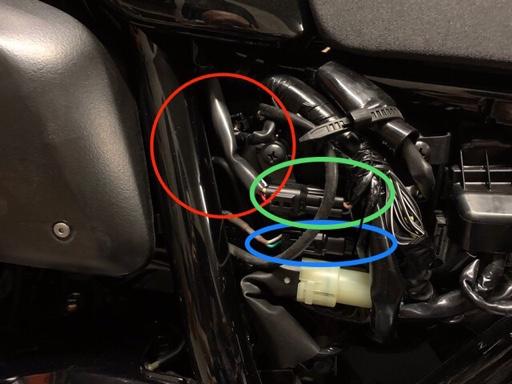
On 3rd picture the red circle was pointed out as the AIr Intake sensor by someone from customer service from boosterplug.com. However I only can find a 2 wire connector (blue circle), but the connectors are not compatible with the boosterplug. The response from boosterplug was that Honda never uses or has used the type of connector for the AI sensor and sincce then no more e-mail assistance from them.

So if someone can point to me with a picture the Air Intake sensor on a Z018 onwards Honda CB1100RS or even on an older model, that would be great. The AI sensor is part 31 on the Honda drawing.

I just want to test it a couple of weeks before deciding if I keep it or not...and the 10 min install as stated on the instructions are already 10b for me
e268638ad6c57e5cc0cb526cbaf05c96.png


Thx!
f24b35dff385c8bd87aa565e976e4e96.jpg
b65e7ea57b0234278f7c9e18131d5abd.jpeg
42e790cf034144b777f8d1a7e3dd52c3.jpg
05a47a55010774baaff4ef480f5cca5b.png


Verzonden vanaf mijn iPad met Tapatalk Pro
 
Tsmetjen they are pointing at the right place with the red circle and none of the connectors you show on the picture will fit.

The one in your hand looks to be the connector in the blue circle which is the sidestand switch, which is easy
to find once you follow the cable down to where the sidestand switch is mounted.
And the connector in the green circle is the fuel tank connector with three wires.


The intake air temperature sensor is the white ( unplugged ) part with the two mounting screws and is located here;


And when connected up looks like this;


At 20 degrees celsius it has a resistance of 2.2 kilo ohm and when warmed to 28 degrees the resistance decreases to 2 kilo ohm.

The cable for this sensor is quite short and a bit difficult to unplug, the connector needs to be pushed forward, then pressed to lift the clip over the little ramp that holds the connector in place and then pulled back.

What is the reason you want to install the booster plug?
 
Thread starter
Houtman_imp said:
To me it sounds that the only thing that plug will do is booster their profit.

Maybe, but that’s not the issue....and not much of a help
2b0294bc38ab8adcdc195fb3fc913abd.png


Verzonden vanaf mijn iPad met Tapatalk Pro
max_imp said:
Tsmetjen they are pointing at the right place with the red circle and none of the connectors you show on the picture will fit.

The one in your hand looks to be the connector in the blue circle which is the sidestand switch, which is easy
to find once you follow the cable down to where the sidestand switch is mounted.
And the connector in the green circle is the fuel tank connector with three wires.


The intake air temperature sensor is the white ( unplugged ) part with the two mounting screws and is located here;


And when connected up looks like this;


At 20 degrees celsius it has a resistance of 2.2 kilo ohm and when warmed to 28 degrees the resistance decreases to 2 kilo ohm.

The cable for this sensor is quite short and a bit difficult to unplug, the connector needs to be pushed forward, then pressed to lift the clip over the little ramp that holds the connector in place and then pulled back.

What is the reason you want to install the booster plug?

Thx....i will check it ,

The reason I want to try is is because their marketing got me
7b8b38e7bf392ec3010f84b988ec9f2c.png
, and I wanted to to something in the corona lockdown

Seriously, i don’t have a clue if it will change something or not, I just want to find out.


Verzonden vanaf mijn iPad met Tapatalk Pro
 
Although it is less than ideal, it is also only half the cost of a new power commander.

So with that being said- adding more fuel regardless of method will be beneficial.

Have fun!
 
Do you guys care enough about your $5k+ bike to argue over a couple hundred?

That last link is stretchy in their description.

Like something bell said - “If you have a $10 head, wear a $10 helmet”

The Dynojet power commander is 110% safe unless you choose to f around with the maps and have no idea what you are changing.

It is also 1,000 more capable.

For not that much more in comparison to the cost of the bike.


Sent from my iPhone using Tapatalk
 
tsmetjen_imp said:
Hi, i can use some technical help on installng the boosterplug I recently received.
On 3rd picture the red circle was pointed out as the AIr Intake sensor by someone from customer service from boosterplug.com. However I only can find a 2 wire connector (blue circle), but the connectors are not compatible with the boosterplug. The response from boosterplug was that Honda never uses or has used the type of connector for the AI sensor and sincce then no more e-mail assistance from them.

So if someone can point to me with a picture the Air Intake sensor on a Z018 onwards Honda CB1100RS or even on an older model, that would be great. The AI sensor is part 31 on the Honda drawing.

I just want to test it a couple of weeks before deciding if I keep it or not...and the 10 min install as stated on the instructions are already 10b for me
e268638ad6c57e5cc0cb526cbaf05c96.png


Thx!
f24b35dff385c8bd87aa565e976e4e96.jpg
b65e7ea57b0234278f7c9e18131d5abd.jpeg
42e790cf034144b777f8d1a7e3dd52c3.jpg
05a47a55010774baaff4ef480f5cca5b.png


Verzonden vanaf mijn iPad met Tapatalk Pro
Hi, glad someone bought them for the CB1100 before I did to see if they work. I did buy the Booster Plug for my 2018 Z900RS because I installed Akrapovic Header Pipes, Akrapovic Exhaust and a K&N Air Filter. I read their brochure and it seems to make logical sense. My Kawasaki is way faster with all I put on thus far, but burps every once in awhile. My next Corona Project, this week is to install the Booster Plug to see if it evens out my fuel consumption and eliminates the occasional backfire from too much fuel.
I will repost after I install and test ride.
PowerDubs_imp said:
Although it is less than ideal, it is also only half the cost of a new power commander.

So with that being said- adding more fuel regardless of method will be beneficial.

Have fun!
Hi, I posted above I bought the Booster Plug for my Z900RS because I think it needs it, and possibly my 2013 CB1100 because it has a K&N Air Filter and Yoshimura Exhaust. Anytime you use more air, you need more fuel, and the Booster Plug claims to map out the fuel to the ambient air temperature/ air consumption. It should work. I see no reason for installing on it my 2017 CB1100EX since I am keeping those beautiful, stock header pipes all chrome with no bluing, etc....
 
Quote: I did buy the Booster Plug for my 2018 Z900RS because I installed Akrapovic Header Pipes, Akrapovic Exhaust and a K&N Air Filter. ....I read their brochure and it seems to make logical sense........My next Corona Project, this week is to install the Booster Plug to see if it evens out my fuel consumption and eliminates the occasional backfire from too much fuel.

And this is an example of where things get dangerous- you installed 3 things that increase airflow - and now think you are running rich?

Backfire can happen from running too lean, not just rich.

If you *think* you are rich, but are already lean- don’t ‘jet’ the other way, else bow down and pray- you’ve got a holy piston.

73b7863b73ac69a98833d34b301e0ea5.png


Sent from my iPhone using Tapatalk
 
I think our cb works more something on the technical heat limit .. I would never want to intervene in the engine control .. if I do not know all the technical contex/ correlation exactly
and
i don't live on the racetrack where it matters every second...and i have no budget to buy short a new engine after a race...

but everyone has to know for themselves
 
PowerDubs_imp said:
Quote: I did buy the Booster Plug for my 2018 Z900RS because I installed Akrapovic Header Pipes, Akrapovic Exhaust and a K&N Air Filter. ....I read their brochure and it seems to make logical sense........My next Corona Project, this week is to install the Booster Plug to see if it evens out my fuel consumption and eliminates the occasional backfire from too much fuel.

And this is an example of where things get dangerous- you installed 3 things that increase airflow - and now think you are running rich?

Backfire can happen from running too lean, not just rich.

If you *think* you are rich, but are already lean- don’t ‘jet’ the other way, else bow down and pray- you’ve got a holy piston.

73b7863b73ac69a98833d34b301e0ea5.png


Sent from my iPhone using Tapatalk

And this is an example of where things get dangerous- you installed 3 things that increase airflow - and now think you are running rich?

Backfire can happen from running too lean, not just rich.

If you *think* you are rich, but are already lean- don’t ‘jet’ the other way, else bow down and pray- you’ve got a holy piston.

31adcb863b4cda4dafd10528e5e4660f.png


Sent from my iPhone using Tapatalk Hi, thanks for the reply. The Booster plug claims to only adjust fuel by the actual (ambient) air temperature, providing a richer mixture at low RPM's, and accelerating, and a leaner mixture at idle or at a steady speed. In theory, it should work great if it can do what it claims, and adjusting fuel continuously it better than doing it by increments the way the Power Commander works.
 
Intake Air Temperature (IAT).
The purpose of the IAT sensor is for the Engine Control Module (ECM) to correct for air density changes when ambient air temperature changes.
The colder the air the more dense it is, therefore more oxygen content, so the ECM make a correction to add a bit more fuel to the basic fuel injection calculation.
The ECM correction factor for the IAT is negligible, so modifying the IAT output to trick the ECM for more power is not worth it.
Having said that, the Engine Coolant Temperature (ECT) sensor has more correction value percentage (compared to the IAT) to the basic fuel injection calculation, since the CB1100 does not have a radiator, the ECM uses the Engine Oil Temperature (EOT) sensor instead to compensate from a cold to a fully warm up engine.
The EOT sensor uses the same type of Negative Thermal Coefficient (NTC) thermistor as the IAT, meaning when the engine is hot, her resistance drops.
(At 20 degrees celsius it has a resistance of 2.2 kilo ohm and when warmed to 28 degrees the resistance decreases to 2 kilo ohm.)

Basic Fuel Injection Calculation:
For the ECM to calculate the basic fuel output, it requires signals from the Manifold Absolute Pressure (MAP) sensor and Engine RPM (NE) then it add the correction factors such as EOT, IAT ,Ox and so on.

Hope this help
Alain
 
I tried one of these Boosterplugs on my Triumph T120 because it was a bit snatchy. Did it work? No. Not in my opinion. The only difference I could tell was the exhaust fumes smelt much more 'petrolly'. Like it was running on full choke.

Anyhow, took it off and sold it on eBay for about half what I paid. Another life lesson.......
 
On many of the previous posts I see : it should , they claim , it might ,it could.
To me that does not make sense , it works or it does not work if you install parts related to the engine . Last year I looked at the booster plug and quickly decided that it did not make sense to ME.
 
Alain Lee_imp said:
Intake Air Temperature (IAT).
The purpose of the IAT sensor is for the Engine Control Module (ECM) to correct for air density changes when ambient air temperature changes.
The colder the air the more dense it is, therefore more oxygen content, so the ECM make a correction to add a bit more fuel to the basic fuel injection calculation.
The ECM correction factor for the IAT is negligible, so modifying the IAT output to trick the ECM for more power is not worth it.
Having said that, the Engine Coolant Temperature (ECT) sensor has more correction value percentage (compared to the IAT) to the basic fuel injection calculation, since the CB1100 does not have a radiator, the ECM uses the Engine Oil Temperature (EOT) sensor instead to compensate from a cold to a fully warm up engine.
The EOT sensor uses the same type of Negative Thermal Coefficient (NTC) thermistor as the IAT, meaning when the engine is hot, her resistance drops.
(At 20 degrees celsius it has a resistance of 2.2 kilo ohm and when warmed to 28 degrees the resistance decreases to 2 kilo ohm.)

Basic Fuel Injection Calculation:
For the ECM to calculate the basic fuel output, it requires signals from the Manifold Absolute Pressure (MAP) sensor and Engine RPM (NE) then it add the correction factors such as EOT, IAT ,Ox and so on.

Hope this help
Alain
Hi, thanks, every bit of info helps. I am not putting the Booster Plug on either of my Hondas, I do not think they need any help. I am pretty sure factory settings must be on the lean side some. I am hoping it helps with fuel usage on my Z900RS. If it does not work or does nothing, I will remove it. What is there on the market I can do for my Kawasaki that has Akrapovic Headers, Akrapovic Exhaust and a K&N Air Filter, all of which make it breath more, but do not add more fuel to match the increase air intake. Are the components in these new, computer driven bikes able to compensate for the increase in air? I hope so. I have put about 300 miles on the Kawasaki already and the only negative outcome I see is my mpg went down a little and an occasional pop on downshifting. I am old school and still engine brake some. Not so much it hurts the engine, but enough to be in the right gear as I slow down.
 
michael1954_imp said:
Alain Lee_imp said:
Intake Air Temperature (IAT).
The purpose of the IAT sensor is for the Engine Control Module (ECM) to correct for air density changes when ambient air temperature changes.
The colder the air the more dense it is, therefore more oxygen content, so the ECM make a correction to add a bit more fuel to the basic fuel injection calculation.
The ECM correction factor for the IAT is negligible, so modifying the IAT output to trick the ECM for more power is not worth it.
Having said that, the Engine Coolant Temperature (ECT) sensor has more correction value percentage (compared to the IAT) to the basic fuel injection calculation, since the CB1100 does not have a radiator, the ECM uses the Engine Oil Temperature (EOT) sensor instead to compensate from a cold to a fully warm up engine.
The EOT sensor uses the same type of Negative Thermal Coefficient (NTC) thermistor as the IAT, meaning when the engine is hot, her resistance drops.
(At 20 degrees celsius it has a resistance of 2.2 kilo ohm and when warmed to 28 degrees the resistance decreases to 2 kilo ohm.)

Basic Fuel Injection Calculation:
For the ECM to calculate the basic fuel output, it requires signals from the Manifold Absolute Pressure (MAP) sensor and Engine RPM (NE) then it add the correction factors such as EOT, IAT ,Ox and so on.

Hope this help
Alain
Hi, thanks, every bit of info helps. I am not putting the Booster Plug on either of my Hondas, I do not think they need any help. I am pretty sure factory settings must be on the lean side some. I am hoping it helps with fuel usage on my Z900RS. If it does not work or does nothing, I will remove it. What is there on the market I can do for my Kawasaki that has Akrapovic Headers, Akrapovic Exhaust and a K&N Air Filter, all of which make it breath more, but do not add more fuel to match the increase air intake. Are the components in these new, computer driven bikes able to compensate for the increase in air? I hope so. I have put about 300 miles on the Kawasaki already and the only negative outcome I see is my mpg went down a little and an occasional pop on downshifting. I am old school and still engine brake some. Not so much it hurts the engine, but enough to be in the right gear as I slow down.
Hi Michael, Sorry I cannot help you in regards to modification for more power - It's beyond my pay grade.
In regards to your comments on "Factory setting on the lean side" - this is not true at all, it is a perception by many people. The factory engineers & their suppliers (BOSCH or DENSO or DELPHI etc) must program the ECM to meet emission, fuel consumption and power, in other word they must get the perfect combustion (14.7:1 ratio) on every stroke and this is confirmed via the Oxygen sensor (Air Fuel Ratio sensor on later models).
Example of where the engineers can get saving on fuel consumption is to create less friction from internal moving parts (less piston rings tension, drill holes between cylinders to reduce pumping loss, use teflon coating etc), cut fuel injection during engine deceleration, using the knock sensor to advance ignition timing to the maximum, use Variable valve timing technology, low resistance tires, low drag coefficient design of the body, low friction oil* etc.
(*Low Friction Oil - that's why the automobile engine oil cannot be used on motorcycle because it will create slippage of the clutch).

"all of which make it breath more, but do not add more fuel to match the increase air intake" - Mike, You have to remember that 100% of incoming air is measured by the MAP sensor and the ECM while confirming the engine RPM will calculate the correct/proper amount of fuel required - no less/no more.
However, let's say if there is some corossion build up in the EOT sensor circuitry; the ECM will assume that the engine is cooler (when it is really hot) then ECM will compensate by adding more fuel than required causing a richer mixture (example 11:1 ratio instead of 14.7:1) therefore more power output - note: after a while the ECM will learn and trigger a Diagnostic Trouble Code (DTC).

Alain
 
Alain i wonder if you can help me out on this one;
"that 100% of incoming air is measured by the MAP sensor"etc.

I have always thought that the volume of air was measured by a Mass Air Flow sensor using two very small resistors placed strategically in the airflow before the air filter measuring the volt drop ( temperature difference ) between them and translating that into an output signal to the e.c.m.

Do you mean that the same air volume can be measured by the Manifold Air Pressure sensor measuring vacuum on the intake manifold?
I'm a bit unclear on that one and never worked out the role of the map sensor.
 
Alain Lee_imp said:
michael1954_imp said:
Alain Lee_imp said:
Intake Air Temperature (IAT).
The purpose of the IAT sensor is for the Engine Control Module (ECM) to correct for air density changes when ambient air temperature changes.
The colder the air the more dense it is, therefore more oxygen content, so the ECM make a correction to add a bit more fuel to the basic fuel injection calculation.
The ECM correction factor for the IAT is negligible, so modifying the IAT output to trick the ECM for more power is not worth it.
Having said that, the Engine Coolant Temperature (ECT) sensor has more correction value percentage (compared to the IAT) to the basic fuel injection calculation, since the CB1100 does not have a radiator, the ECM uses the Engine Oil Temperature (EOT) sensor instead to compensate from a cold to a fully warm up engine.
The EOT sensor uses the same type of Negative Thermal Coefficient (NTC) thermistor as the IAT, meaning when the engine is hot, her resistance drops.
(At 20 degrees celsius it has a resistance of 2.2 kilo ohm and when warmed to 28 degrees the resistance decreases to 2 kilo ohm.)

Basic Fuel Injection Calculation:
For the ECM to calculate the basic fuel output, it requires signals from the Manifold Absolute Pressure (MAP) sensor and Engine RPM (NE) then it add the correction factors such as EOT, IAT ,Ox and so on.

Hope this help
Alain
Hi, thanks, every bit of info helps. I am not putting the Booster Plug on either of my Hondas, I do not think they need any help. I am pretty sure factory settings must be on the lean side some. I am hoping it helps with fuel usage on my Z900RS. If it does not work or does nothing, I will remove it. What is there on the market I can do for my Kawasaki that has Akrapovic Headers, Akrapovic Exhaust and a K&N Air Filter, all of which make it breath more, but do not add more fuel to match the increase air intake. Are the components in these new, computer driven bikes able to compensate for the increase in air? I hope so. I have put about 300 miles on the Kawasaki already and the only negative outcome I see is my mpg went down a little and an occasional pop on downshifting. I am old school and still engine brake some. Not so much it hurts the engine, but enough to be in the right gear as I slow down.
Hi Michael, Sorry I cannot help you in regards to modification for more power - It's beyond my pay grade.
In regards to your comments on "Factory setting on the lean side" - this is not true at all, it is a perception by many people. The factory engineers & their suppliers (BOSCH or DENSO or DELPHI etc) must program the ECM to meet emission, fuel consumption and power, in other word they must get the perfect combustion (14.7:1 ratio) on every stroke and this is confirmed via the Oxygen sensor (Air Fuel Ratio sensor on later models).
Example of where the engineers can get saving on fuel consumption is to create less friction from internal moving parts (less piston rings tension, drill holes between cylinders to reduce pumping loss, use teflon coating etc), cut fuel injection during engine deceleration, using the knock sensor to advance ignition timing to the maximum, use Variable valve timing technology, low resistance tires, low drag coefficient design of the body, low friction oil* etc.
(*Low Friction Oil - that's why the automobile engine oil cannot be used on motorcycle because it will create slippage of the clutch).

"all of which make it breath more, but do not add more fuel to match the increase air intake" - Mike, You have to remember that 100% of incoming air is measured by the MAP sensor and the ECM while confirming the engine RPM will calculate the correct/proper amount of fuel required - no less/no more.
However, let's say if there is some corossion build up in the EOT sensor circuitry; the ECM will assume that the engine is cooler (when it is really hot) then ECM will compensate by adding more fuel than required causing a richer mixture (example 11:1 ratio instead of 14.7:1) therefore more power output - note: after a while the ECM will learn and trigger a Diagnostic Trouble Code (DTC).

Alain
Hi, thanks, every bit of info helps. I am not putting the Booster Plug on either of my Hondas, I do not think they need any help. I am pretty sure factory settings must be on the lean side some. I am hoping it helps with fuel usage on my Z900RS. If it does not work or does nothing, I will remove it. What is there on the market I can do for my Kawasaki that has Akrapovic Headers, Akrapovic Exhaust and a K&N Air Filter, all of which make it breath more, but do not add more fuel to match the increase air intake. Are the components in these new, computer driven bikes able to compensate for the increase in air? I hope so. I have put about 300 miles on the Kawasaki already and the only negative outcome I see is my mpg went down a little and an occasional pop on downshifting. I am old school and still engine brake some. Not so much it hurts the engine, but enough to be in the right gear as I slow down.
Hi Michael, Sorry I cannot help you in regards to modification for more power - It's beyond my pay grade.
In regards to your comments on "Factory setting on the lean side" - this is not true at all, it is a perception by many people. The factory engineers & their suppliers (BOSCH or DENSO or DELPHI etc) must program the ECM to meet emission, fuel consumption and power, in other word they must get the perfect combustion (14.7:1 ratio) on every stroke and this is confirmed via the Oxygen sensor (Air Fuel Ratio sensor on later models).
Example of where the engineers can get saving on fuel consumption is to create less friction from internal moving parts (less piston rings tension, drill holes between cylinders to reduce pumping loss, use teflon coating etc), cut fuel injection during engine deceleration, using the knock sensor to advance ignition timing to the maximum, use Variable valve timing technology, low resistance tires, low drag coefficient design of the body, low friction oil* etc.
(*Low Friction Oil - that's why the automobile engine oil cannot be used on motorcycle because it will create slippage of the clutch).

"all of which make it breath more, but do not add more fuel to match the increase air intake" - Mike, You have to remember that 100% of incoming air is measured by the MAP sensor and the ECM while confirming the engine RPM will calculate the correct/proper amount of fuel required - no less/no more.
However, let's say if there is some corossion build up in the EOT sensor circuitry; the ECM will assume that the engine is cooler (when it is really hot) then ECM will compensate by adding more fuel than required causing a richer mixture (example 11:1 ratio instead of 14.7:1) therefore more power output - note: after a while the ECM will learn and trigger a Diagnostic Trouble Code (DTC).

Alain Thanks again, but I do not think the Booster Plug is sold under the guise of getting more HP, but to smooth out the general rideability of the bike. The New Z900RS tends to be a little jumpy off throttle, I guess is the best way to put it. It may be only a 948cc engine, but it has quite a bit more HP than either of my CB1100's. I think I read stock having about 101HP. The new pipes, etc...I added, according to some test I read online claim about a 25HP gain, making it even more peppy.
Booster Plug according to its literature does not claim any HP increase, only a smoother ride. Reading dozens of reviews from users of it, several on the Z900RS, claim it does just that, make the bike less unpredictable. Both of my Honda CB1100's are very smooth and have an even power delivery that makes riding them very enjoyable, at least for me, and I suppose most of this forum too. I am leaving their engines alone, I like the way they handle and will not buy the Booster plug for either one. The Kawasaki, according to several reviewers of the BP, claim jumpy throttle response, hence the BP to help. I will install it on the Kawasaki soon and report back here what I gain (or lose).

 
Quote:I think I read stock having about 101HP. The new pipes, etc...I added, according to some test I read online claim about a 25HP gain, making it even more peppy.
25HP gain with only filter- and pipe mods .... I'd really like to read that online test.
 
If I remember correctly- my old ZRX1200 picked up ..... *edit- just went back and looked- 16.6whp from pipe and jets.


Alain- you are giving the factory injection too much credit. It is NOT smart enough to 'calculate the correct/proper amount of fuel required - no less/no more.' It will not adjust for 100% of the air for any modifications done to the bike.

It is simply built to run correctly on a stock bike and hit an emissions target. It does NOT have a wideband O2 sensor from the factory. Just a plain old simple narrow band.

While it isn't as crude as old CIS or Digifant injection- it is still basic in it's operation to meet it's goal. Once the intake/exhaust is changed outside of it's initial design parameter, the fueling is no longer correct.
To the guy that mentioned the Z900 above, check this out- Ivan's Performance Products
 
PowerDubs_imp said:
If I remember correctly- my old ZRX1200 picked up ..... *edit- just went back and looked- 16.6whp from pipe and jets.


Alain- you are giving the factory injection too much credit. It is NOT smart enough to 'calculate the correct/proper amount of fuel required - no less/no more.' It will not adjust for 100% of the air for any modifications done to the bike.

It is simply built to run correctly on a stock bike and hit an emissions target. It does NOT have a wideband O2 sensor from the factory. Just a plain old simple narrow band.

While it isn't as crude as old CIS or Digifant injection- it is still basic in it's operation to meet it's goal. Once the intake/exhaust is changed outside of it's initial design parameter, the fueling is no longer correct.
To the guy that mentioned the Z900 above, check this out- Ivan's Performance Products
THANKS Josh! Just read the page you sent...I think this guy is on to something. I am going to contact Ivan. Me set up on my Z900RS is almost identical to what he has fixed. I am using the Akrapovic Exhaust though instead of the stock exhaust with the Akrapovic Headers & K&N Air Fliter. His mods to the air box look inviting and he does get the almost 25 HP from his bike with all his mods. A little scary to cut holes in the air box, but the jumpiness his page talks about is real, just ride one of these and you will love the CB1100's smoothness even more, but it is a babe in the woods when it comes to matching HP with the Kawasaki, even stock. I may not even waste my time with the Booster Plug and just give him my changes to my bike and go from there. Again, Josh, thanks....Michael
 
Back
Top