
checking chain tension

fredkb_imp

Running like a top
Thread starter
When checking chain tension, the owners manual shows chain in normal position and chain pushed up. Should you measure from that position as illustrated, or do you measure from chain fully pushed down and then fully pushed up?

Sent from my SAMSUNG-SGH-I337 using Tapatalk


Sent from my SAMSUNG-SGH-I337 using Tapatalk
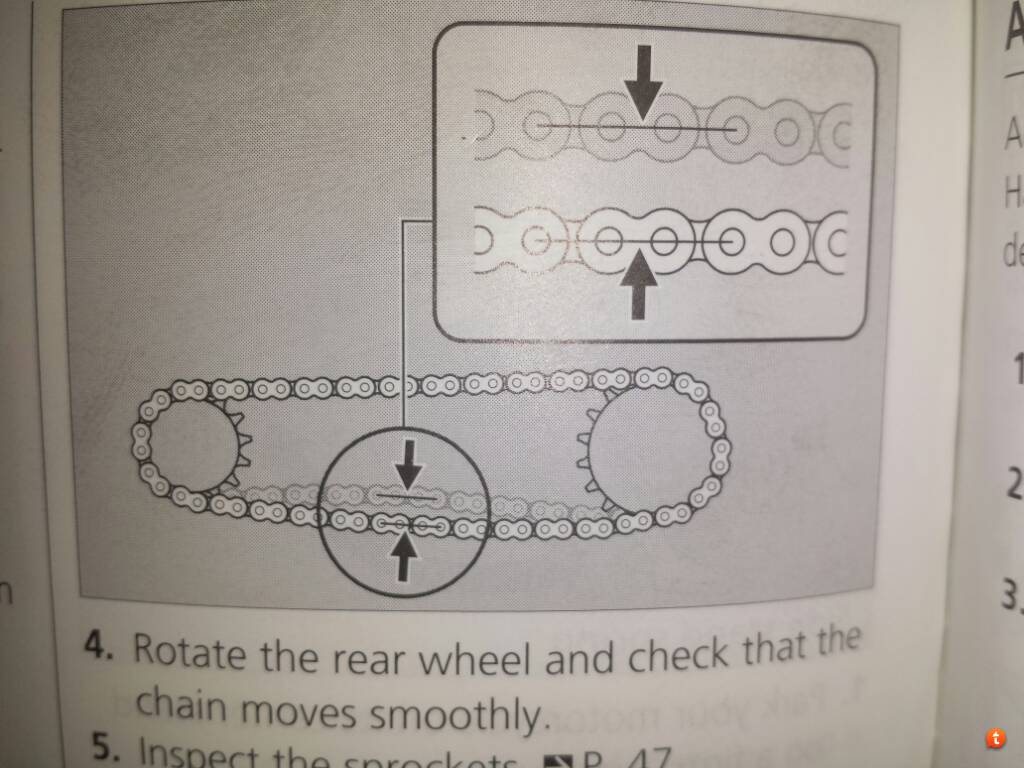
 
Full droop till it stops (up).
 
Thread starter
fredkb_imp said:
When checking chain tension, the owners manual shows chain in normal position and chain pushed up. Should you measure from that position as illustrated, or do you measure from chain fully pushed down and then fully pushed up?

Sent from my SAMSUNG-SGH-I337 using Tapatalk


Sent from my SAMSUNG-SGH-I337 using Tapatalk
11f427b633dd1c7e7583e78b626e599f.jpg


Sent from my SAMSUNG-SGH-I337 using Tapatalk
 
Fred from center of pins in static position to center of pins in pushed up position half way between sprockets measured in several places and adjusted at tightest spot. (although you could use any part of the chain..bottom edge, or top edge as long as you use same part for both measurements, but center of pin is an easy one)

There is some controversy in that the manual calls for a free play of 1-1.4" ( one and four tenths? Or nearly 1 1/2") and the sticker on the side of the swingarm ( which you can barely see btw on the deluxe lol) calls for 1 - 1 1/4" of slack.
 
My guess is that the sticker just gives a single value in the middle of the range as a reference (and directs you to the owners manual for details). The sticker value is 30mm or 1 1/4", which is right in the middle of the 25mm-35mm range in the manual.
 
Should the slack be measured while the bike is on its center stand (rear wheel off the ground) or on its side stand?
 
draces1_imp said:
Should the slack be measured while the bike is on its center stand (rear wheel off the ground) or on its side stand?
There will be a difference in chain tension when on the side stand. When on the center stand the chain will be at maximum slack. I like to do the adjustment while on the center stand and chain cool.
 
Been waiting for another chain thread.

Anyway, if you're on center stand per manual and before you touch the chain, the weight of the chain will cause both the top and the bottom run to sag about the same amount. There is nothing that makes all the slack go to the bottom of the chain by itself. You will notice that when you push up in the bottom, the top moves tighter at the same time. In the diagram the top run is straight so to me it is not shown in "normal" or "static" position. You have to pull on the bottom a little bit first so that for your starting point and end point none of the slack is in the top run....for the most accurate measurement..

you might not want to do this though because some might get their chain too tight if they make a little measurement error while going for the tight end of the range. IMO, adjust to mid range of the spec.
 
But the manual says to rotate the rear wheel first. Won't that pull the slack out of the top? Then do the measurement at the bottom as shown and it should be good I would think.
 
which manual popgun? I don't remember reading that. if you turned the wheel taking all the slack out of the top and putting it all at the bottom, I would think that would make the adjustment too tight when the suspension is compressed. I've never heard of adjusting a chain like that before, and in 17 years in the business I have seen zillions of chains adjusted. Not saying it isn't the correct way to do it, just never read that before.
 
Lord Popgun_imp said:
But the manual says to rotate the rear wheel first. Won't that pull the slack out of the top? Then do the measurement at the bottom as shown and it should be good I would think.
Agree if the top stays straight but the front sprocket is free wheeling so it might not stay the same after you let go of the wheel. I think you rotate to find the tightest spot for measuring.
 
Deanohh_imp said:
Lord Popgun_imp said:
But the manual says to rotate the rear wheel first. Won't that pull the slack out of the top? Then do the measurement at the bottom as shown and it should be good I would think.
Agree if the top stays straight but the front sprocket is free wheeling so it might not stay the same after you let go of the wheel. I think you rotate to find the tightest spot for measuring.
I misunderstood waht popgun was referring to.That's to make sure their is no binding, that the wheel and axle are square and to check for binding links and tight spots. That has nothing to do with tension.
 
To find those tight links, I put a little spot of red paint on one of the side plate after wiping it clean, makes finding the tight links next time easy peasy.
 
Deanohh_imp said:
I never had any tight links but are the same ones tight over and over again and what do you do about it when you find one?
Dean I've never seen a stiff link, become un stiff on a modern bike. In the old days, you'd take out the master link, remove the chain and soak it in a pan of warm oil and work the link back and forth to loosen them up, but generally once it " kinks" as they call it, the chain must be replaced.
 
Yup. On an O-ring chain, a binding link usually indicates that the O-ring failed and the lube has departed the roller. With a damaged O-ring, there's no way to reliably get lube back into the roller (and keep it there). That usually means the chain is done for. You definitely do not want to ride with a binding link. The chain could snap at any time. Best case, you're stuck on the side of the road. Worst case you're spread all over the road.

If you were determined not to replace the chain, I suppose you could cut out the damaged link and replace it with a master link. This can open up another can of worms, since 99% of the broken chains I've seen were the result of an improperly installed master link.
 
Back
Top