


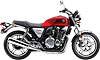

A few of you have asked why am I spending the time, money, and effort to help save what Guth once referred to as a “tired and weary forum.” The answer is simple. During one of the worst times of my life, the CB1100 Forum helped me.
I spent 18 months looking for the right 2017 CB1100 to purchase. Shortly after I purchased the motorcycle, I was assaulted. I am an avid cyclist. I ride more miles on a bicycle each year than a motorcycle. While on a training ride in July 2024, a car carrying some idiot Tik Tokers decided to throw a brick at me while I was riding my bike. I was going 25 miles per hour when the brick stuck my chest. As I was losing control of my Bianchi road bike, I knew I had two choices: take my chances drifting into the oncoming lane of traffic or crash the bicycle on the side of the road. I planted the bike and did the best I could to distribute the force across my body. There is a lot of momentum at 25 miles per hour, and the abrupt crash fractured my shoulder, hip, pelvis, and knee. Despite world class safety gear, I also bruised my brain. The last thing I remember was hitting the ground and trying to unclip from the bike pedals and crawl to the side of the road.
The paramedics arrived and removed my helmet, secured me for transport, and off I went to a trauma center for emergency surgery. Thankfully, a surgeon familiar with sports injuries was on call and he pieced me back together. I have new suspension :
:
![[Image: aM4rPFY.jpeg]](https://i.imgur.com/aM4rPFY.jpeg)
When they rolled me into the ER, the surgeon told me that I should place my affairs in order because over 50% of the people who have this kind of injury at my age die in the first 12 months. He also told me to plan on taking off from work for six months and trying to recover slowly. I told him neither was going to happen and he had three weeks to get me to the point I could walk out of the hospital or I would crawl. But I was leaving in three weeks.
When they gave me my first Oxy pain dosage, I liked it. I really, really, really liked it. So much so, I told them we were done with that and I would take Tylenol and find a way to work through the pain. That way was the CB1100 Forum. I knew I had a motorcycle waiting for me as soon as I could extract myself from the Emergency Room. I spent each day reading this Forum, getting to know the good people who joined it, laughing at lame jokes, learning about the underlying engineering of a CB1100, falling in love with RLETs, and trying to ignore the pain.
I spend three hours a day rehabbing still. I have had to lose weight to accommodate the changes to my body. There are good days and bad days. But the Forum, and the promise of another day on a beautiful motorcycle, motivated me as much as family, friends, and faith. Thank you for what you did for me, and I hope that in some small way my work on this site to keep this Tribe together helps even our score. I remain in your debt.
Everyone always eventually asks me about the Tik Tokers and what came of them. When the Police told me that they had them and wanted to know what I wanted to have happened, I told them Counseling, not Prison. I would like to believe that they had no clue what could happen and just how fast an old man can ride a bike. Whether it is accurate or not does not matter, I am a devout Catholic who simply did not want to become consumed by the worst parts of my personality. I believe in 2nd chances and redemption because I have needed both countless times.
I am now going to ride my CB1100 on the prettiest road I can find. Have a great day. David
I spent 18 months looking for the right 2017 CB1100 to purchase. Shortly after I purchased the motorcycle, I was assaulted. I am an avid cyclist. I ride more miles on a bicycle each year than a motorcycle. While on a training ride in July 2024, a car carrying some idiot Tik Tokers decided to throw a brick at me while I was riding my bike. I was going 25 miles per hour when the brick stuck my chest. As I was losing control of my Bianchi road bike, I knew I had two choices: take my chances drifting into the oncoming lane of traffic or crash the bicycle on the side of the road. I planted the bike and did the best I could to distribute the force across my body. There is a lot of momentum at 25 miles per hour, and the abrupt crash fractured my shoulder, hip, pelvis, and knee. Despite world class safety gear, I also bruised my brain. The last thing I remember was hitting the ground and trying to unclip from the bike pedals and crawl to the side of the road.
The paramedics arrived and removed my helmet, secured me for transport, and off I went to a trauma center for emergency surgery. Thankfully, a surgeon familiar with sports injuries was on call and he pieced me back together. I have new suspension
:When they rolled me into the ER, the surgeon told me that I should place my affairs in order because over 50% of the people who have this kind of injury at my age die in the first 12 months. He also told me to plan on taking off from work for six months and trying to recover slowly. I told him neither was going to happen and he had three weeks to get me to the point I could walk out of the hospital or I would crawl. But I was leaving in three weeks.
When they gave me my first Oxy pain dosage, I liked it. I really, really, really liked it. So much so, I told them we were done with that and I would take Tylenol and find a way to work through the pain. That way was the CB1100 Forum. I knew I had a motorcycle waiting for me as soon as I could extract myself from the Emergency Room. I spent each day reading this Forum, getting to know the good people who joined it, laughing at lame jokes, learning about the underlying engineering of a CB1100, falling in love with RLETs, and trying to ignore the pain.
I spend three hours a day rehabbing still. I have had to lose weight to accommodate the changes to my body. There are good days and bad days. But the Forum, and the promise of another day on a beautiful motorcycle, motivated me as much as family, friends, and faith. Thank you for what you did for me, and I hope that in some small way my work on this site to keep this Tribe together helps even our score. I remain in your debt.
Everyone always eventually asks me about the Tik Tokers and what came of them. When the Police told me that they had them and wanted to know what I wanted to have happened, I told them Counseling, not Prison. I would like to believe that they had no clue what could happen and just how fast an old man can ride a bike. Whether it is accurate or not does not matter, I am a devout Catholic who simply did not want to become consumed by the worst parts of my personality. I believe in 2nd chances and redemption because I have needed both countless times.
I am now going to ride my CB1100 on the prettiest road I can find. Have a great day. David


